Legal work has always been personal, stressful, and paperwork-heavy. Whether someone is going through a divorce, buying a home, filing an injury claim, or preparing immigration documents, the legal process can feel confusing and slow.
This is why Legal Automation Startups are becoming so important. Instead of building one generic tool for every lawyer and every case type, many new Legal Tech Startups are going deeper into one specific legal workflow.
The opportunity is no longer just “automate documents.” The real opportunity is to build focused Legal Automation Software that understands a specific legal journey end-to-end.
Introduction: Why Legal Automation Is Going Vertical
For years, legal technology focused on broad tools: document storage, e-signatures, billing software, and generic form builders. These tools helped, but they did not always solve the deeper workflow problems inside law firms.
A divorce lawyer does not work like a personal injury lawyer. A mortgage closing workflow does not look like an immigration case. A debt collection process has different risks, timelines, documents, and compliance needs than estate planning.
That is why Legal Automation Startups are going vertical.
Vertical legal automation means building software for one focused legal area instead of trying to automate everything. These platforms are designed around the exact steps, documents, approvals, deadlines, and client emotions involved in a specific legal process.
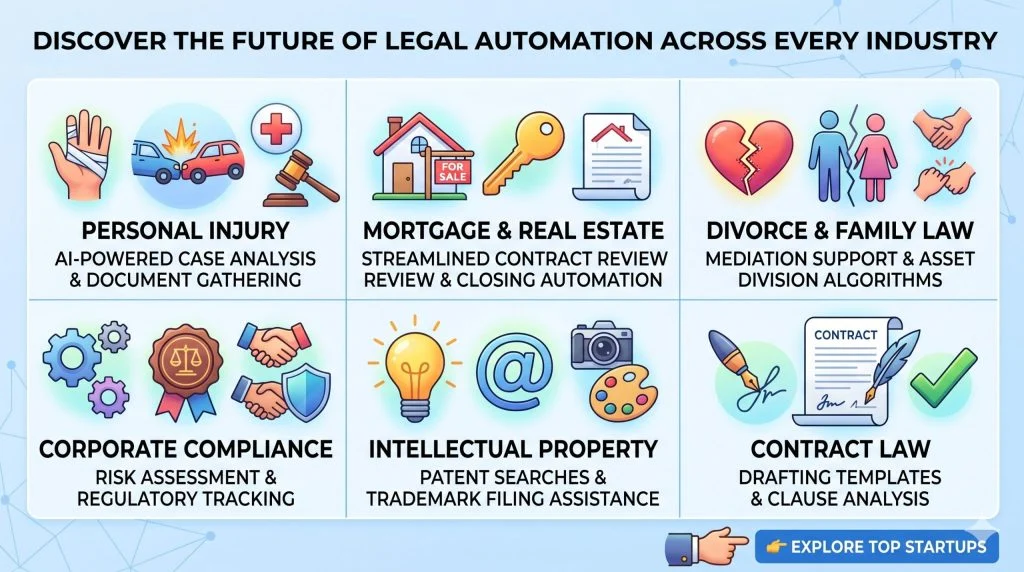
For example, a divorce automation platform may handle intake, parenting plans, financial disclosures, settlement drafts, and court-ready forms. A personal injury automation platform may focus on medical records, claim timelines, demand letters, and settlement tracking.This is where modern AI Legal Startups can create real value. With the right workflow design, AI can support smarter intake, document review, client summaries, and task recommendations. Platforms like Docassemble can also help teams build structured legal workflows with AI capabilities. You can explore this further through AI and LLM integration for legal workflows.
What Are Vertical Legal Automation Startups?
Vertical Legal Automation Startups are companies that solve one narrow legal problem deeply.
Instead of saying, “We automate legal documents,” they say:
- “We automate divorce intake and settlement documents.”
- “We automate mortgage closing workflows.”
- “We help PI firms generate demand packages faster.”
- “We help immigration lawyers collect client documents and prepare forms.”
This focused approach works because legal services are not one-size-fits-all. Every practice area has its own language, documents, client journey, court requirements, and operational bottlenecks.
A vertical legal automation platform usually includes:
- Smart intake forms
- Document generation
- Workflow tracking
- E-signatures
- Client portals
- Case dashboards
- Lawyer review steps
- Payment workflows
- AI summaries
- Compliance checks
The best Legal SaaS Platforms do not replace legal expertise. They remove repetitive admin work so lawyers and legal teams can focus on judgment, strategy, and client support.
Why Vertical Legal Automation Is Growing Fast
The legal industry is under pressure from many sides. Clients want faster service. Law firms want better margins. Lawyers are overloaded with admin work. Courts and compliance processes still depend heavily on documents.
At the same time, AI has made automation more practical and more accessible.
This combination is creating a strong opening for Legal Process Automation Tools.
Rising Legal Costs
Legal services can be expensive, especially in areas like divorce, real estate, immigration, and personal injury. Automation can reduce repetitive work and help firms serve more clients efficiently.
Higher Client Expectations
Clients now expect digital experiences. They want online forms, status updates, secure uploads, e-signatures, and simple communication. They do not want to email documents back and forth for weeks.
Lawyer Workload
Many legal teams spend hours on repetitive intake, drafting, checking, formatting, and follow-ups. Automation can reduce this workload without removing lawyer oversight.
Document-Heavy Workflows
Legal work is full of forms, letters, agreements, notices, filings, disclosures, and supporting documents. This makes Document Automation for Law Firms one of the strongest use cases in legal tech.
AI Adoption
AI is making it easier to summarize information, review documents, extract key details, and guide users through complex workflows. The future is not just document automation; it is intelligent workflow automation.
Key Features Found in Legal Automation Startups
Smart Intake Forms
Smart intake forms collect client information in a structured way. Instead of asking clients to send long emails, the platform guides them through questions step by step.
Good intake forms can adjust based on user answers. For example, a divorce intake form may ask different questions if children are involved.
Document Automation
Document automation turns structured intake data into legal documents, letters, forms, agreements, or internal summaries.
This saves time and reduces copy-paste errors. It is especially useful for repeatable documents like NDAs, wills, demand letters, notices, and disclosure forms.
E-Signature Workflows
Many legal workflows require signatures from clients, lawyers, opposing parties, witnesses, or business stakeholders. Built-in e-signature workflows make the process faster and easier to track.
Case Tracking Dashboards
Dashboards help legal teams see where every case stands. They can track missing documents, pending reviews, deadlines, payment status, and next actions.
Client Communication Portals
A client portal gives clients one secure place to upload files, answer questions, check progress, and receive updates. This improves trust and reduces repeated emails.
AI Review and Summaries
AI can summarize client responses, review documents, identify missing information, and prepare first-draft notes for lawyers.
For more advanced use cases, firms can build legal AI agents that guide users, extract information, and support structured workflows. This is where legal AI agent development can become valuable.
Payment and Billing Automation
Legal automation platforms may include payment links, subscription billing, invoice generation, and payment tracking. This is useful for fixed-fee legal services and self-serve legal products.
12 Vertical Legal Automation Startup Ideas and Examples
1. Divorce Automation Startup
Divorce is emotional, document-heavy, and often confusing. A divorce automation startup can help lawyers and clients move through the process with more structure.
The platform could automate:
- Client intake
- Financial disclosure forms
- Parenting plan questionnaires
- Asset and liability summaries
- Settlement document drafts
- Court filing preparation
- Client communication
- Deadline reminders
The emotional side matters here. Clients going through divorce are often stressed and overwhelmed. A good platform should not feel cold or robotic. It should make the process clearer, calmer, and more organized.
For law firms, this type of platform can reduce admin time and improve client experience.
2. Mortgage Closing Automation Startup
Mortgage closing involves lenders, title companies, law firms, buyers, sellers, brokers, and banks. It is one of the best areas for Legal Automation Software because the workflow is highly structured and document-heavy.
A mortgage closing automation startup could support:
- Closing checklists
- Title document tracking
- Compliance review
- E-signature workflows
- Buyer and seller information collection
- Document status dashboards
- Approval workflows
- Closing package generation
This can help reduce delays and errors in real estate transactions.
For more complex legal workflows, an API-first workflow engine can help connect forms, approvals, documents, and external systems. Docassemble’s API-first legal workflow engine is a useful reference for this type of architecture.
3. Personal Injury Case Automation Startup
Personal injury law firms handle many moving parts: client intake, accident details, medical records, insurance communication, treatment timelines, evidence, demand letters, and settlement tracking.
A PI automation startup could help firms manage:
- New claim intake
- Accident questionnaires
- Medical record requests
- Insurance details
- Treatment status
- Demand letter generation
- Settlement timelines
- Case value summaries
- Client updates
The biggest value is speed and organization. PI firms often manage many cases at once. Automation helps them avoid missed records, delayed follow-ups, and inconsistent documentation.
This is a strong market for AI Legal Startups because AI can summarize medical records, extract claim details, and help draft case summaries for lawyer review.
4. Immigration Legal Automation Startup
Immigration law is form-heavy and deadline-sensitive. Clients often need to submit many personal documents, government forms, identity records, employment details, financial information, and supporting evidence.
An immigration automation startup could support:
- Eligibility questionnaires
- Visa-specific intake flows
- Document checklists
- Client portals
- Form preparation
- Case status updates
- Deadline reminders
- Lawyer review workflows
This type of product must be especially careful with accuracy, privacy, and jurisdiction-specific requirements.
The user experience also matters. Immigration clients may be anxious about their future, family, job, or legal status. A good platform should explain steps clearly and reduce confusion.
5. Estate Planning Automation Startup
Estate planning is a strong area for Document Automation for Law Firms because many documents follow structured patterns.
An estate planning platform could help generate:
- Wills
- Trusts
- Powers of attorney
- Healthcare directives
- Beneficiary forms
- Asset summaries
- Family information questionnaires
It can also help lawyers manage client reviews, updates, and signing appointments.
The human side is important here too. Estate planning is not just paperwork. Clients are thinking about family, legacy, safety, and future protection. The platform should feel trustworthy and simple.
6. Employment Law Automation Startup
Employment law covers both employee-side and employer-side workflows. A vertical automation startup could focus on HR compliance, employee claims, workplace policies, or employment documents.
Possible workflows include:
- Employment agreement generation
- Termination documentation
- Workplace complaint intake
- HR policy review
- Severance agreement workflows
- Misclassification checks
- Internal investigation forms
- Compliance reminders
For businesses, this can reduce risk and improve consistency. For law firms, it can make repetitive employment law workflows easier to manage.
This is a good area for Legal SaaS Platforms because businesses may need ongoing subscriptions rather than one-time document generation.
7. Real Estate Legal Automation Startup
Real estate legal work involves contracts, disclosures, title documents, lease agreements, amendments, and transaction coordination.
A real estate legal automation startup could help with:
- Purchase agreement workflows
- Lease review checklists
- Disclosure forms
- Title document tracking
- Transaction dashboards
- Closing document preparation
- Buyer and seller communication
- Lawyer approval steps
This product could serve real estate law firms, title companies, brokers, property managers, and lenders.
Because real estate transactions are time-sensitive, automation can reduce delays and improve visibility for everyone involved.
8. Debt Collection Legal Automation Startup
Debt collection is repetitive, regulated, and document-heavy. Firms must manage notices, repayment plans, legal letters, case status, and compliance workflows.
A debt collection automation startup could include:
- Debtor intake
- Notice generation
- Payment plan workflows
- Legal letter templates
- Court document preparation
- Compliance checks
- Case tracking
- Payment reminders
This area needs careful compliance design. Communication rules, consumer protection laws, and documentation accuracy are critical.
A maker-checker workflow can help reduce risk by requiring review before documents are finalized. Platforms like Docassemble can support maker-checker legal document workflows for situations where accuracy matters.
9. Small Business Contract Automation Startup
Small businesses need legal documents but often cannot afford ongoing legal support for every contract.
A startup focused on small business contract automation could help generate:
- NDAs
- Service agreements
- Vendor contracts
- Founder agreements
- Contractor agreements
- Partnership agreements
- Renewal reminders
- Contract summaries
This product could be sold as a subscription to startups, agencies, consultants, and small business owners.
However, the platform should clearly separate legal information from legal advice and include lawyer review options where needed.
10. Insurance Claim Legal Automation Startup
Insurance claims often involve policy documents, claim forms, evidence, correspondence, deadlines, and disputes.
An insurance claim automation startup could support:
- Claim intake
- Policy upload and review
- Evidence collection
- Document requests
- Claim status tracking
- Dispute workflows
- Settlement communication
- Legal escalation steps
This platform could serve policyholders, law firms, public adjusters, or insurance-focused legal teams.
AI can be useful here for summarizing policy terms, identifying missing documents, and organizing claim evidence.
11. Legal Aid and Self-Represented Litigant Automation Startup
Many people cannot afford full legal representation. Legal aid organizations and self-represented litigants need tools that make legal processes easier to understand.
This type of startup could help users:
- Understand legal steps
- Complete guided interviews
- Generate court forms
- Prepare filing checklists
- Track deadlines
- Learn what documents are needed
- Get plain-language explanations
This area has huge social impact. The product must be simple, accessible, and careful with language.
The best legal aid automation tools do not pretend to replace lawyers. They help people navigate basic steps more confidently and reduce avoidable mistakes.
12. Healthcare Compliance Legal Automation Startup
Healthcare providers face many legal and compliance workflows, from consent forms to HIPAA-related documentation and vendor agreements.
A healthcare compliance automation startup could support:
- Consent form generation
- HIPAA workflow documentation
- Vendor agreement review
- Audit trails
- Patient authorization forms
- Compliance checklists
- Policy updates
- Staff acknowledgment workflows
This can be useful for clinics, telehealth providers, healthcare startups, and compliance teams.
Because healthcare data is sensitive, privacy and security must be built into the platform from day one.
Why Narrow Legal Automation Beats Generic Legal Tech
Generic legal tools are useful, but they often stop at the surface. They help store documents, collect signatures, or generate templates. But they may not understand the full workflow.
Vertical Legal Automation Startups go deeper.
A focused divorce platform knows about parenting plans, financial disclosures, marital assets, and settlement steps. A PI platform understands medical records, demand letters, and claim timelines. A mortgage closing platform understands title documents, lender requirements, and closing packages.
This depth creates better products.
Narrow legal automation works because it understands:
- The user’s real pain
- The exact document types
- The required review steps
- The emotional context
- The compliance risks
- The deadlines
- The business model of the law firm
In legal tech, depth often beats breadth.
Business Models for Vertical Legal Automation Startups
SaaS Subscription
Law firms or businesses pay a monthly or yearly subscription. This works well for ongoing workflows like employment law, contract management, debt collection, and healthcare compliance.
Per-Document Pricing
Users pay for each generated document. This can work for estate planning, small business contracts, or self-service legal tools.
Law Firm Licensing
A startup can license the platform to law firms as an internal tool. The firm uses it to serve clients faster while maintaining lawyer oversight.
Marketplace Revenue
Some platforms may connect clients with lawyers and earn revenue from referrals, service fees, or transaction-based pricing.
White-Label Legal Portals
A startup can provide white-label portals for law firms. The firm gets a branded client intake and automation experience without building software from scratch.
Challenges These Legal Automation Startups Must Solve
Legal automation is promising, but it is not easy. Trust matters. Accuracy matters. Compliance matters.
Legal Compliance
Every legal workflow must follow rules. Startups need to understand what can be automated and where lawyer review is required.
Jurisdiction Differences
Legal rules vary by state, court, and practice area. A divorce form in one state may not work in another. This is a major challenge in the USA.
Data Privacy
Legal platforms handle sensitive information. Security, encryption, access controls, and audit logs are essential.
Lawyer Oversight
AI and automation should support lawyers, not bypass them in risky situations. Many workflows need review and approval before final output.
Court Filing Rules
Court rules can be strict. Forms, formats, deadlines, and filing procedures may vary.
Document Accuracy
Errors in legal documents can create serious consequences. Platforms need validation, review workflows, and clear accountability.
User Trust
Legal problems are stressful. Users need to feel that the platform is reliable, transparent, and safe.
Future of Vertical Legal Automation
The future of legal automation will be more intelligent, more workflow-driven, and more human-centered.
AI will help with:
- Smarter intake
- Document review
- Legal summaries
- Missing information detection
- Workflow recommendations
- Client-facing explanations
- Risk flagging
- Draft preparation
But the winning products will not be generic chatbots. They will be structured platforms that combine legal workflows, forms, rules, AI, document automation, and human review.The best Legal Process Automation Tools will feel like guided legal operating systems for specific practice areas.
For law firms, this means faster service and better client experience. For clients, it means less confusion and more transparency. For founders, it means there is still a lot of room to build focused legal products that solve real problems.
Final Thoughts
The biggest opportunity in legal tech is not simply “AI for all legal work.”
The real opportunity is focused automation for painful, repeatable legal workflows.
That is why vertical Legal Automation Startups are so interesting. Divorce, mortgages, personal injury, immigration, estate planning, employment law, real estate, debt collection, contracts, insurance claims, legal aid, and healthcare compliance all have clear workflows that can be improved.
The winners will be the startups that understand one legal problem deeply and build around the full journey — intake, documents, review, communication, payments, compliance, and client experience.
Legal automation is not about removing the human side of law. It is about giving lawyers and clients better tools for some of the most stressful moments in life.
FAQs
What is vertical legal automation?
Vertical legal automation is software built for one specific legal workflow or practice area, such as divorce, personal injury, immigration, mortgage closing, or estate planning.
Why are legal automation startups focusing on specific niches?
Startups are focusing on niches because each legal workflow has different documents, rules, deadlines, risks, and client needs. A focused product can solve the problem better than a generic tool.
Can AI replace lawyers in legal automation workflows?
No, AI should not fully replace lawyers in complex legal matters. It can support intake, summaries, document drafting, and review, but legal judgment and responsibility still require human oversight.
Which legal workflows are best for automation?
The best workflows for automation are repetitive, document-heavy, rule-based, and high-volume. Examples include intake forms, NDAs, divorce documents, immigration forms, estate planning, mortgage closing, and PI demand letters.
How do legal automation startups make money?
They can make money through SaaS subscriptions, per-document pricing, law firm licensing, marketplace models, or white-label legal portals.
What should founders consider before building a legal automation startup?
Founders should consider the legal niche, jurisdiction rules, document complexity, lawyer review needs, data privacy, workflow design, and how the product will create real value for both lawyers and clients.

 English