DocAssemble Development

automation

Docassemble Development Cost Benefits for Mid-Size Businesses (2026)

Cost Benefits of Docassemble Development for Mid‑Size Businesses

Introduction: docassemble isn’t “document automation” – it’s operational leverage Mid-size teams (including legal aid organizations) usually hit the same wall: your workload grows faster than your headcount. Intake volume rises, forms multiply, staff spend hours copying answers into PDFs, and small mistakes turn into rework, delays, or compliance risk. That’s where docassemble development becomes a cost strategy—not just a tech project. Docassemble is a free, open-source platform for guided interviews and document assembly (built on Python + YAML + Markdown) that can generate PDF, DOCX, and RTF outputs from user input.For legal aid and other document-heavy services, that means you capture information once, validate it in real time, and generate consistent documents and packets—without endless copy/paste. In this guide, we’ll break down the real cost benefits of docassemble development for mid-size organizations: where the savings show up, how to measure ROI, and what a production-ready implementation actually includes (with a small technical code section).What costs do assemble reduces (the “before vs after” reality) 1) Staff time spent on repeat data entry The biggest invisible cost in document workflows is retyping the same answers: With docassemble, you structure inputs once and reuse variables across multiple outputs (PDF/DOCX/RTF). Cost impact: fewer staff hours per case, and less overtime during peaks. 2) Rework from small errors (the “oops tax”) Manual document preparation fails in predictable places: Docassemble interviews can validate inputs before generating documents, which reduces rework. Cost impact: fewer back-and-forth edits and fewer rejected submissions. 3) Training and dependency on “tribal knowledge” When workflows live in someone’s head or in a messy folder of templates, onboarding new staff is expensive. Docassemble turns workflows into maintainable interview logic (YAML), which makes processes repeatable and easier to hand over. Cost impact: faster onboarding, fewer “only Sarah knows how to do this” bottlenecks. Why this matters for legal aid organizations (even if you’re “mid-size”) Legal aid teams are often mid-size in staff, but “enterprise-level” in complexity: Docassemble is widely used in legal services because it produces consistent outputs and supports integrations when needed. It’s also MIT-licensed, which gives flexibility for customization and packaging. Why this matters for legal aid organizations (even if you’re “mid-size”) Legal aid teams are often mid-size in staff, but “enterprise-level” in complexity: Docassemble is widely used in legal services because it produces consistent outputs and supports integrations when needed. It’s also MIT-licensed, which gives flexibility for customization and packaging. What “production-grade docassemble development” includes A working interview in a dev environment is not the same as a reliable production workflow. A strong docassemble development implementation typically includes: 1) Interview design that matches real operations 2) Document templates that stay stable Docassemble can generate documents in PDF/DOCX/RTF, using templates and document assembly tools.Your build should include versioning for forms (because forms change). 3) Secure deployment + maintenance hygiene Even mid-size orgs need: 4) Integration readiness (when you want it) Docassemble offers an HTTP API, authenticated using an API key header like X-API-Key.This is useful when you want to: Technical code section: generating documents + converting formats Docassemble interviews are written in YAML, and user answers are stored in variables you can use in documents.  Example: generate a DOCX (and offer PDF too) Common objections (and the honest answers) “We already have templates—why build this?” Templates are static. Your workload is dynamic. Docassemble adds: “Isn’t open-source risky?” Open-source isn’t the risk—unmanaged deployments are. With the right security practices and maintenance process, open-source can be a cost and flexibility advantage. Plus, docassemble’s MIT licensing is permissive.  Ready to turn templates into a real system? We build production-grade docassemble interviews, PDF/DOCX generation, and API integrations—designed for mid-size legal aid teams. Get in touch FAQs 1) What exactly is docassemble development? It’s building guided interviews and document assembly workflows in docassemble (YAML + Python) so user input generates consistent outputs like PDF/DOCX/RTF. 2) What documents can docassemble generate? Docassemble can generate PDF, DOCX, and RTF documents from interview answers. 3) How fast can a mid-size team see ROI? Often quickly—because the first wins come from reduced retyping and fewer document errors. The fastest ROI is usually one high-volume workflow (intake + packet). 4) Can docassemble integrate with our existing systems? Yes. Docassemble provides an HTTP API, commonly authenticated via X-API-Key. 5) Can we convert DOCX to PDF automatically? Yes. Docassemble supports converting files to formats like pdf and docx using .convert_to(). 6) Is docassemble suitable for legal aid organizations globally? Yes—because it’s flexible (supports different forms and jurisdictions) and can be deployed in ways that match local compliance and operational needs.

Cost Benefits of Docassemble Development for Mid‑Size Businesses Read More »

Docassemble vs Salesforce: Which Automation Tool Fits Legal Aid Workflows?

Comparison: Docassemble vs Salesforce Automation Tools

Introduction Legal aid teams in the US and UK are under the same pressure: serve more people, with less time, while keeping quality high. That’s why “automation tools” show up in almost every roadmap—especially Salesforce (for case intake + CRM workflows) and Docassemble (for guided interviews + document generation). But they solve different problems. Salesforce automation tools are great at moving records through a system: tasks, approvals, reminders, routing, case status updates. Docassemble is great at turning human answers into court-ready documents through interview logic-PDF/DOCX/RTF-without staff retyping the same facts again and again. So the real question in docassemble vs Salesforce isn’t “which is better?” It’s: what should be the system of record, and what should be the document engine? This comparison is written for legal aid organizations (US + UK) and the developers supporting them-so you can pick the right architecture, reduce staff workload, and avoid building something that looks automated but still requires humans to clean up the mess. What Docassemble is best at (and why legal aid teams love it) Docassemble is a free, open-source platform for guided interviews and document assembly, built on Python/YAML/Markdown, and it can generate documents in PDF, DOCX, and RTF. Where it shines for legal aid: If your biggest bottleneck is “we keep re-entering the same facts into forms,” Docassemble tends to deliver immediate impact. What Salesforce automation tools are best at Salesforce’s strength is the workflow around the case: So if your bottleneck is “we can’t manage volume, routing, and follow-ups,” Salesforce automation tools are a strong fit. But: Salesforce document generation is often “template merge + workflow,” while Docassemble is “interview logic + legal logic + document output.” Those are related, but not interchangeable. docassemble vs Salesforce: the real comparison (what to use when) 1) Intake and case workflow Best practice in legal aid is often: Salesforce manages the case; Docassemble handles the interview + documents. 2) Legal logic and branching rules 3) Document quality and court readiness If your forms are sensitive to missing clauses, conditional paragraphs, or court formatting, Docassemble is typically the safer engine. 4) Integration flexibility Docassemble can be controlled via an HTTP API (API key authenticated), and you can build custom front-ends that talk to Docassemble sessions.Salesforce has a huge integration ecosystem, but the key question is: where does the “truth” live, and who owns the interview session state? 5) Data control and deployment model Docassemble being open-source means legal aid orgs can self-host for stronger control. Want the “Docassemble + Salesforce” integration blueprint for legal aid? Share your workflow (intake → eligibility → documents → case file) and we’ll recommend the cleanest architecture and rollout plan. Get in touch The model that works best for legal aid orgs:  Salesforce as system of record, Docassemble as document engine Here’s the pattern we see work repeatedly: This reduces double entry and keeps staff focused on help—not admin. DocassembleDevelopment.com explicitly focuses on building secure, scalable docassemble solutions and real-world workflow automation, including integrations and production readiness. Technical section: simple integration pattern (Salesforce → Docassemble → Salesforce) A) Start a Docassemble session from an external system (example) Docassemble supports an HTTP API authenticated using an API key. B) Best-practice notes (what avoids breakage) Need a team to build this end-to-end (without breaking production)? We help legal aid orgs implement Docassemble interviews, integrate via the docassemble api, and deploy secure, maintainable systems. Get in touch FAQs  1) Is docassemble vs Salesforce an either/or decision? Not usually. Salesforce is often the case system; Docassemble is the legal interview + document assembly engine. They work best together. 2) When should a legal aid org choose Docassemble first? When your biggest pain is repetitive form filling, inconsistent documents, or complex interview logic that staff can’t reliably “remember” across matters. 3) When should a legal aid org choose Salesforce automation first? When intake operations are the bottleneck: assignment, follow-ups, case status tracking, internal routing, and workload management. 4) Can Docassemble integrate with Salesforce? Yes. Docassemble provides an HTTP API, and you can also build custom front ends that communicate with Docassemble sessions via the API. 5) What documents can Docassemble generate? Docassemble can generate documents in PDF, DOCX, and RTF formats. 6) What’s the biggest integration mistake teams make? Treating document assembly like “just merge fields.” Legal workflows need branching logic, validation, audit trails, and failure-safe integration patterns—especially at legal aid scale. 

Comparison: Docassemble vs Salesforce Automation Tools Read More »

How to Build a High‑Performance Docassemble App for Healthcare

How to Build a High‑Performance Docassemble App for Healthcare

Introduction Healthcare paperwork is everywhere—intake forms, consent documents, eligibility affidavits, release-of-information requests, benefit appeals, and follow-up letters. For legal aid teams working in medical-legal partnerships (MLPs) or supporting vulnerable patients, these workflows can become a daily bottleneck: repetitive interviews, rushed document prep, missing details, and constant back-and-forth. That’s where healthcare automation becomes a real advantage. With docassemble, you can turn complex healthcare + legal workflows into guided, accessible interviews that produce consistent, compliant documents in minutes—not days. But in healthcare contexts, “working” isn’t enough. Your app must be fast, reliable, secure, and resilient under real-world conditions. This guide shows how to build a high-performance docassemble app for healthcare-related workflows—optimized for speed, stability, and trust—while keeping the experience human and inclusive for users worldwide. 1) Start with the healthcare workflow, not the document A common mistake is building from a template first. In healthcare and legal aid, the real “product” is the interview experience—because the interview determines accuracy, patient comfort, and legal safety. Start by mapping: When your flow is clear, you can generate documents (PDF/DOCX) reliably with fewer edits and fewer support tickets. 2) Build for “speed of understanding” first High performance isn’t only server response time—it’s also how quickly a user can complete a task without confusion. In healthcare legal aid apps: This is healthcare automation with dignity: the interview should feel like a supportive guide, not a form. 3) Make it scalable: design your docassemble project like software Even if your first version is small, treat it like a product that will grow. Recommended structure: This makes upgrades safer and faster—especially for global deployments where you might support multiple jurisdictions and languages. 4) Performance foundations that matter in production Here are the practical engineering moves that make a docassemble project feel “instant” at scale: A) Minimize heavy objects early Don’t load large lists, complex objects, or call external APIs at the start of the interview. Delay expensive steps until they’re truly needed. B) Cache anything reusable If you use reference data (clinics, benefit programs, common providers), cache it so every interview isn’t doing the same work. C) Use background tasks when appropriate For expensive document generation or API calls, consider asynchronous/background patterns so the UI stays responsive. D) Keep templates clean Messy DOCX templates and over-complex Jinja logic can slow document assembly. Prefer: 5) Security and privacy: healthcare needs “quietly strong” safeguards Healthcare-related interviews often involve protected and sensitive information. Even for legal aid, you should design with healthcare-grade privacy habits: Even if you’re not a covered entity, privacy expectations are high—and users notice when a system feels safe. 6) Technical code section: a production-minded pattern (Docassemble YAML + Python) Below is a simplified pattern you can adapt for a healthcare intake + authorization workflow. It demonstrates: Example: Interview skeleton (YAML) Example: Helper validation (Python module idea) You can keep helper logic in a small Python file for reuse across multiple docassemble app interviews. 7) Integrations: when to use APIs (and when not to) It’s tempting to integrate everything: EMRs, scheduling, CRMs, case management, payment tools. But high performance means being selective. Use a docassemble api integration when it: Avoid integrations that: A reliable “manual fallback” is often the difference between a tool that works daily vs. a tool staff avoids. 8) Where legal aid fits: healthcare automation for real impact For global legal aid, healthcare-related workflows show up in many forms: A well-built docassemble legal tool can turn these into repeatable workflows that are: That’s the practical promise of healthcare automation—and it’s why this kind of work scales impact, not just output. If you’re building a healthcare-focused docassemble workflow for legal aid (intake, appeals, authorizations, multilingual), reply with your use case—we’ll share a ready-to-use structure + performance checklist. Get in touch FAQs  1) Can docassemble be used for healthcare workflows even if we’re a legal aid organization? Yes. Many healthcare-related processes have legal steps (benefits, consent, disputes, documentation). docassemble is ideal for guided interviews that generate letters, affidavits, and forms consistently. 2) What makes a Docassemble app “high-performance” in real life? It loads fast, asks only what’s necessary, handles errors gracefully, and keeps documents consistent. Technically, it avoids unnecessary API calls, caches reference data, and keeps templates clean. 3) How do we protect sensitive information in a healthcare automation interview? Log carefully, minimize stored data, lock down access roles, and never expose secrets on the client side. Treat any integration keys (including docassemble api keys) like high-privilege credentials. 4) Should we generate PDF or DOCX for healthcare-related documents? DOCX is great for staff edits; PDF is better for final delivery and consistency. Many teams generate DOCX for review and export PDF for signing/submission. 5) What’s the fastest healthcare workflow to automate first? Start with a high-volume, repetitive process: intake + triage, release/authorization requests, or benefits appeal letters. These show immediate time savings and reduce errors quickly.

How to Build a High‑Performance Docassemble App for Healthcare Read More »

How Docassemble Development Saves Time in Legal Tech Workflows

How Docassemble Development Saves Time in Legal Tech Workflows

Introduction If you’ve ever watched a legal team rebuild the same intake form, chase missing details over email, then manually copy-paste those answers into a Word template… you already know where time disappears. It doesn’t vanish in one dramatic place. It leaks out through small, repeated steps—every new matter, every new client, every new deadline. That’s exactly what Docassemble Development fixes. Docassemble is an open-source platform for guided interviews and document assembly—built on YAML + Python + Markdown—so you can collect structured inputs once and generate consistent outputs (PDF, DOCX, RTF) every time.For US law firms and legal aid organizations, that means faster intake, fewer errors, and workflows that are repeatable across practice areas—without relying on “tribal knowledge” or endless template editing. Where legal workflows waste time (and why it keeps happening) Most legal teams don’t have a “time problem.” They have a “repeat work problem.” Common workflow bottlenecks: These steps aren’t just slow—they’re risky. They create rework, confusion, and avoidable mistakes. What “Docassemble development” actually means in practice Docassemble isn’t a single template or a plug-and-play form builder. Think of it like a “workflow engine” for legal processes. With Docassemble Development, you build: Docassemble interviews are written in YAML and can include Python modules for more advanced logic. The real “time savings” comes from one idea: capture once, reuse everywhere Here’s the core value: you ask for information once, then Docassemble reuses it across the entire workflow. Example: Immigration / family law / landlord-tenant intake Instead of: You get: That shift saves time in 3 ways: Workflow upgrades law firms and legal aid teams can feel immediately 1) Smart intake that doesn’t feel like paperwork Docassemble can run as a web-based interview (what many people casually call a docassemble app) that asks one question at a time, adapts based on answers, and prevents missing fields early. 2) Built-in branching for real-world complexity Your workflow isn’t linear. Docassemble doesn’t force it to be. You can branch on: 3) Consistent documents (with less attorney cleanup) When every document is assembled from the same structured inputs, your drafts stop being “first drafts that need a rewrite” and become “review drafts that need decisions.” 4) Faster scaling across teams and locations Legal aid organizations often need the same workflow across multiple offices and volunteers. Docassemble enables standardization while still allowing localized rules. Where Docassemble automation delivers the biggest ROI (US context) Intake + eligibility (especially for legal aid) Guided eligibility logic can reduce staff time spent triaging and ensure clients land in the right pathway. Court forms + packets Many matters require multiple documents that reuse the same facts. Automation prevents retyping and keeps packets consistent. High-volume practice areas If you do a lot of similar matters (tenant letters, expungements, simple motions, demand letters, small claims, payment plans), automation stacks savings fast. Multi-user workflows Docassemble can be designed for multi-role collaboration (client → intake staff → attorney review), which matters when teams share workloads.  Common mistakes that reduce time savings  A good legal automation build treats interviews like software: scoped, tested, documented, and maintained. FAQs  1) Is Docassemble only for legal aid? No. Legal aid uses it heavily, but law firms use docassemble for intake, demand letters, pleadings, client communications, and repeatable workflows—especially where accuracy and speed matter. 2) How long does it take to build a Docassemble workflow? A simple intake + one document can be built quickly. More complex workflows (multi-jurisdiction rules, multiple docs, integrations) take longer because the logic and testing matter more than the template itself. 3) Can Docassemble generate PDF and DOCX? Yes. Docassemble supports generating documents in formats like PDF, DOCX, and RTF based on interview answers. 4) What’s the difference between “docassembly” and docassemble? “Docassembly” is often used as a casual term for document assembly/document automation. docassemble is the specific open-source platform that powers guided interviews and document generation. 5) Can we integrate using a docassemble api approach? Yes—many teams integrate Docassemble with existing systems (CRMs, client portals, payments, e-sign, identity). The exact approach depends on your deployment and data flow goals, but integration is a common reason firms invest in custom Docassemble Development. 6) Will attorneys still need to review documents? Yes—and that’s a good thing. Automation should remove repetitive drafting, not legal judgment. The goal is to turn “drafting from scratch” into “reviewing a reliable draft.

How Docassemble Development Saves Time in Legal Tech Workflows Read More »

Docassemble vs HotDocs: Which Document Automation Platform Wins in 2026?

Docassemble vs HotDocs: Which Document Automation Platform Wins in 2026?

In today’s fast-paced world, businesses and organizations are looking for ways to automate and streamline document generation processes. With document automation software, you can create customizable templates, collect user data through interactive forms, and generate documents in various formats. Two of the most prominent names in this space are Docassemble and HotDocs. But with advancements in technology and user expectations increasing, which one is the better choice for your document automation needs in 2026? In this article, we’ll dive into Docassemble vs HotDocs, comparing their features, ease of use, pricing, and flexibility to help you make an informed decision. What Is Docassemble? Docassemble is a powerful, open-source document automation platform that allows users to create interactive interviews and generate customized documents in formats such as PDF, DOCX, and RTF. This flexibility makes Docassemble ideal for businesses looking to generate documents based on user input, whether it’s for legal documents, contracts, or any other form of paperwork. One of the biggest selling points of Docassemble is its open-source nature. Unlike many other document automation platforms, Docassemble provides free access to its core features, which means that organizations can download, modify, and customize the platform according to their specific needs. Additionally, the Docassemble API allows developers to integrate the platform into existing systems, giving it even more flexibility. What Is HotDocs? On the other hand, HotDocs is a long-established leader in the document automation industry, offering a suite of tools designed for businesses that need to create dynamic documents quickly. HotDocs is particularly well-known in industries like law, finance, and insurance, where document accuracy and efficiency are critical. HotDocs offers a wide range of features, including the ability to generate documents in multiple formats, collaborate on documents in real time, and integrate with other software. However, unlike Docassemble, HotDocs is not open-source and operates on a subscription-based pricing model, which can be a dealbreaker for some businesses, especially startups or smaller enterprises with limited budgets. Key Differences: Docassemble vs HotDocs Let’s break down some of the key features and differences between Docassemble and HotDocs that might influence your decision. 1. Ease of Use Docassemble Docassemble shines when it comes to ease of use for those with technical experience. The platform provides a flexible interface for creating interactive interviews, but it does require some technical knowledge to get the most out of it. The platform uses Python for scripting, so developers familiar with coding will have a seamless experience building dynamic templates and integrating with other systems. One of the key advantages of Docassemble is its ability to build a custom document automation system from scratch, using both the Docassemble app and the Docassemble API. While it’s not as intuitive for non-developers as some other platforms, it’s perfect for teams who have the technical expertise to tailor it to their needs. HotDocs HotDocs is generally considered easier to use for non-technical users, as it comes with a more user-friendly interface. Its drag-and-drop functionality makes it easier to build document templates and automate workflows. However, while it’s user-friendly for document creators, it may not offer the same level of flexibility and customization that Docassemble provides for advanced users or developers. 2. Customization and Flexibility Docassemble Docassemble provides a high level of flexibility and customization, making it a preferred choice for organizations that require tailored solutions. Since it’s open-source, developers can modify the platform’s core functionality and integrate it into a wide range of systems. Whether you want to integrate Docassemble with your CRM, use it in a web application, or modify the user interface, Docassemble provides the freedom to do so. The Docassemble app download and API access make this process even easier. HotDocs While HotDocs is certainly customizable, it operates within a more structured framework, which may limit some advanced customizations. HotDocs offers more out-of-the-box solutions and templates, but if your organization requires a high level of customization or integration with other software, it might be more challenging compared to Docassemble. 3. Pricing and Cost Docassemble One of the biggest advantages of Docassemble is its free, open-source nature. Businesses and developers can download the platform and use it at no cost, with the only costs coming from optional add-ons or support services. For many small businesses or startups, this can be a game-changer. However, there are costs associated with hosting, maintenance, and development, especially if you want to integrate Docassemble into existing systems. But when compared to subscription-based platforms like HotDocs, Docassemble provides a very affordable option, particularly for those who want to avoid ongoing costs. HotDocs HotDocs operates on a subscription-based pricing model, which can be expensive depending on the scale of your organization. While HotDocs offers enterprise-grade solutions and support, it might not be the most cost-effective option for small businesses or individual users. The cost structure of HotDocs is typically based on the number of users or documents generated, which can add up over time. 4. Support and Community Docassemble As an open-source platform, Docassemble relies heavily on its community for support. There is an active user base and developer community that offers resources, forums, and guides to help troubleshoot issues and answer questions. Additionally, you can access official support through third-party service providers if needed. HotDocs In contrast, HotDocs offers dedicated customer support as part of its paid subscription. This can be a significant advantage for organizations that need 24/7 assistance or require more personalized support. HotDocs also provides detailed documentation and resources for users. Docassemble API: A Game-Changer for Developers One of the standout features of Docassemble is its API. The Docassemble API allows developers to integrate the platform into other applications, workflows, and websites. For example, you could integrate Docassemble into your existing CRM system to automatically generate client contracts based on the information entered. This level of integration is invaluable for organizations looking to automate their workflows even further. 5. Document Generation and Formats Docassemble Docassemble supports the generation of documents in multiple formats, including PDF, DOCX, and RTF. The ability to create dynamic documents

Docassemble vs HotDocs: Which Document Automation Platform Wins in 2026? Read More »

Migrating Legacy US Court & Legal Aid Forms to Docassemble

Migrating Legacy US Court & Legal Aid Forms to Docassemble

Quick Overview Migrating U.S. court and legal aid forms to Docassemble enables courts, legal aid organizations, and justice programs to modernize form workflows, improve accessibility, and reduce manual processing. By transforming static PDFs into guided, interview-driven digital forms, organizations can deliver more efficient, user-friendly, and compliant legal services at scale. Summarize with ChatGPT Summarize with Perplexity Across the United States, courts and legal aid organizations rely on thousands of legacy forms—PDFs, Word documents, scanned files, and static templates that have been used for years, sometimes decades. While these forms are familiar, they often create friction for both staff and the public. Manual form filling leads to errors, incomplete submissions, accessibility issues, and delays in legal processes. This is where Docassemble changes the game. By choosing to migrate legal forms to docassemble, courts and legal aid organizations can transform static paperwork into guided, intelligent interviews that generate accurate legal documents automatically. At DocassembleDevelopment, we help US courts and legal aid teams modernize their document workflows through structured, scalable docassemble document automation. This guide explains why migration matters, how it works, and what best practices ensure success. Why Legacy Legal Forms Are Holding Systems Back Most legacy court and legal aid forms were never designed for digital-first workflows. Common challenges include: These issues increase operational costs and slow down justice delivery. Migrating to Docassemble addresses these challenges at the root. What Does It Mean to Migrate Legal Forms to Docassemble? When you migrate legal forms to docassemble, you are not simply converting a PDF into another digital format. You are: This process is commonly referred to as docassemble form migration and is a foundational step toward modern legal service delivery. Key Benefits of Migrating Court & Legal Aid Forms 1. Improved Access to Justice Self-represented litigants can complete interviews step by step, without legal jargon or confusing instructions. 2. Reduced Errors and Rework Logic and validations ensure required fields are completed correctly the first time. 3. Faster Document Generation What once took hours of manual work can be completed in minutes. 4. Scalable Legal Operations Teams can handle more cases without increasing staff workload. 5. Consistency Across Jurisdictions Standardized interviews ensure uniform document quality across courts or programs. Common Forms Migrated to Docassemble US courts and legal aid organizations often migrate court forms to docassemble such as: These are high-volume, rules-driven documents—ideal candidates to automate legal forms with docassemble. Step-by-Step: How Docassemble Form Migration Works Step 1: Analyze the Existing Form We start by reviewing the legacy PDF or Word document: Step 2: Design the Interview Flow Instead of replicating the form visually, we redesign it as a conversation: This is where convert legal forms to docassemble becomes a user-centric process, not a technical one. Step 3: Build the Docassemble Interview Using YAML and Python, the interview is implemented with: Step 4: Generate Court-Ready Documents Docassemble outputs documents in PDF, DOCX, or RTF, matching court formatting requirements. Step 5: Test, Validate, and Launch Thorough testing ensures accuracy, accessibility, and compliance before deployment. Technical Example: Simple Docassemble Migration Conditional Logic Example Conditional Logic Example Document Assembly Snippet Best Practices for US Courts & Legal Aid Organizations To ensure successful migration: These practices make it easier to automate legal forms with docassemble at scale. Security, Compliance, and Accessibility Docassemble supports secure, compliant workflows when implemented correctly: These are essential considerations for public-facing court and legal aid systems in the US. How DocassembleDevelopment Supports Migration Projects At DocassembleDevelopment, we specialize in docassemble form migration for US courts and legal aid organizations. We help teams: Our goal is not just technical migration—but sustainable legal automation. Final Thoughts Legacy legal forms are a bottleneck in modern justice systems. By choosing to migrate legal forms to docassemble, courts and legal aid organizations can improve accuracy, accessibility, and efficiency—without sacrificing legal rigor. Docassemble is not just a tool; it’s a platform for rethinking how legal documents are created and delivered.Docassemble is not just a tool; it’s a platform for rethinking how legal documents are created and delivered. FAQs 1. Why should courts and legal aid organizations migrate legacy forms to Docassemble? Many legacy forms are static, confusing, and prone to errors. When you migrate legal forms to Docassemble, those forms become guided interviews that ask clear questions, apply logic automatically, and generate accurate court-ready documents—saving time for staff and reducing mistakes for users. 2. What types of legal forms are best suited for Docassemble migration? High-volume and rules-based forms work best. These include eviction defense filings, family law petitions, protection orders, immigration documents, and legal aid intake forms. These are commonly chosen to migrate court forms to Docassemble because they benefit most from automation and validation. 3. Is migrating legal forms to Docassemble just a PDF conversion? No. Migration is not a simple file conversion. To convert legal forms to Docassemble, the form is redesigned as a step-by-step interview with plain-language questions, conditional logic, and validations. This approach improves usability and ensures accurate document generation. 4. Do we need technical expertise to maintain Docassemble forms after migration? Basic updates—such as text changes or field updates—can often be handled by trained staff. However, for complex logic, integrations, or large-scale docassemble document automation, ongoing technical support is recommended to ensure long-term stability and compliance. 5. How long does it take to migrate legacy court or legal aid forms to Docassemble? The timeline depends on form complexity. Simple forms may take a few days, while multi-page, logic-heavy forms can take a few weeks. A structured docassemble form migration approach ensures accuracy, testing, and smooth rollout without disrupting existing workflows.


Migrating Legacy US Court & Legal Aid Forms to Docassemble Read More »

What Is Docassemble and Why US Law Firms Are Moving to Open-Source Automation

What Is Docassemble and Why US Law Firms Are Moving to Open-Source Automation

Legal work has always been document-heavy. Contracts, affidavits, pleadings, intake forms, disclosures — every matter starts and ends with paperwork. Yet for decades, most law firms have relied on manual drafting, copy-paste templates, and siloed PDF forms. That’s changing rapidly. Across the United States, law firms, legal aid organizations, and courts are shifting toward open-source legal automation — and one platform is leading that transition: Docassemble.In this guide, we’ll break down what Docassemble is, how it works, and why US law firms are increasingly adopting it as their preferred docassemble legal automation platform. What Is Docassemble? Docassemble is an open-source legal document automation software that allows law firms to create interactive, guided interviews which automatically generate legal documents such as PDFs, DOCX, and RTF files. Instead of manually drafting documents or filling static forms, users answer a series of smart questions. Based on those inputs, Docassemble: At its core, Docassemble combines: This makes it far more powerful than basic form builders. Why Legal Automation Matters More Than Ever US law firms face mounting pressure from all sides: Traditional drafting methods simply don’t scale. That’s why document automation for law firms is no longer a “nice to have” — it’s becoming essential infrastructure. Docassemble solves this by converting legal knowledge into reusable, automated systems. How Docassemble Works (In Simple Terms) Here’s how a typical Docassemble workflow looks: Behind the scenes, Docassemble uses: Why US Law Firms Are Moving to Open-Source Automation 1. No Vendor Lock-In Unlike proprietary tools, open source legal document automation gives law firms full ownership of: This is especially important for firms handling sensitive or regulated legal matters. 2. Built for Real Legal Complexity Many no-code tools fail when legal logic becomes complex. Docassemble handles: This makes docassemble for law firms ideal for areas like: 3. Better Client Experience Modern clients don’t want PDFs. They want: Docassemble interviews feel more like a conversation than paperwork — improving completion rates and reducing back-and-forth. 4. Faster Drafting, Fewer Errors By automating repetitive drafting: That’s the real power of docassemble legal automation. Use Cases: How US Law Firms Use Docassemble Client Intake Automation Document Drafting Legal Aid & Pro Bono Internal Firm Workflows Each use case reinforces why document automation for law firms is becoming standard. Technical Flexibility That Lawyers Don’t Outgrow One major reason firms stick with Docassemble long-term is extensibility. Docassemble supports: This makes it future-proof compared to rigid SaaS tools. Security and Compliance Considerations US law firms care deeply about confidentiality. Docassemble supports: For firms handling regulated data, open source legal document automation provides transparency that closed platforms can’t. Why Docassemble Is Ideal for Growing Law Firms Small and mid-sized firms benefit the most: This is why adoption of docassemble legal automation continues to grow across the US. Common Myths About Docassemble “It’s only for courts or legal aid.” Not true. Many private law firms use it daily. “It’s too technical.” With expert setup, lawyers only see the benefits — not the code. “We already use Word templates.” Templates don’t scale. Automation does. The Future of Legal Work Is Automated Legal automation isn’t about replacing lawyers. It’s about: Docassemble represents a shift toward lawyer-controlled technology, not vendor-controlled platforms. Final Thoughts If your firm still relies on manual drafting, you’re leaving time, money, and client satisfaction on the table. Docassemble legal automation empowers US law firms to transform legal knowledge into efficient, reusable systems — without sacrificing control or compliance. Open-source isn’t the future of legal automation. It’s already here. FAQ 1. What is Docassemble and how is it used by US law firms? Docassemble is an open-source legal document automation platform that helps US law firms create interactive interviews to automatically generate legal documents such as contracts, pleadings, and court forms. Law firms use Docassemble to automate client intake, reduce manual drafting, improve accuracy, and deliver faster legal services while maintaining full control over their workflows and data. 2. Why are US law firms moving to open-source legal automation like Docassemble? US law firms are adopting open-source legal document automation because it eliminates vendor lock-in, allows full customization, and provides greater transparency around data security. Unlike proprietary tools, Docassemble lets firms own their logic, templates, and workflows, making it ideal for firms that want scalable and compliant document automation for law firms. 3. Is Docassemble suitable for small and mid-sized law firms? Yes. Docassemble is especially well-suited for small and mid-sized US law firms because it allows them to start with a single automated workflow and expand gradually. Firms can automate repetitive documents, reduce operational costs, and improve turnaround time without hiring additional staff — making docassemble legal automation a practical growth solution. 4. What types of legal documents can be automated using Docassemble? Docassemble supports automated legal form generation for a wide range of documents, including engagement letters, contracts, affidavits, court filings, estate planning documents, and compliance forms. Its rule-based logic ensures that each document adapts automatically based on client inputs, jurisdiction, and case type. 5. Do law firms need technical expertise to use Docassemble? Law firms do not need in-house technical expertise to benefit from Docassemble. While the platform is highly flexible and developer-friendly, most firms work with Docassemble specialists to set up workflows. Once implemented, lawyers and staff interact only with user-friendly interviews — gaining the benefits of legal document automation software without managing the technical complexity.

What Is Docassemble and Why US Law Firms Are Moving to Open-Source Automation Read More »

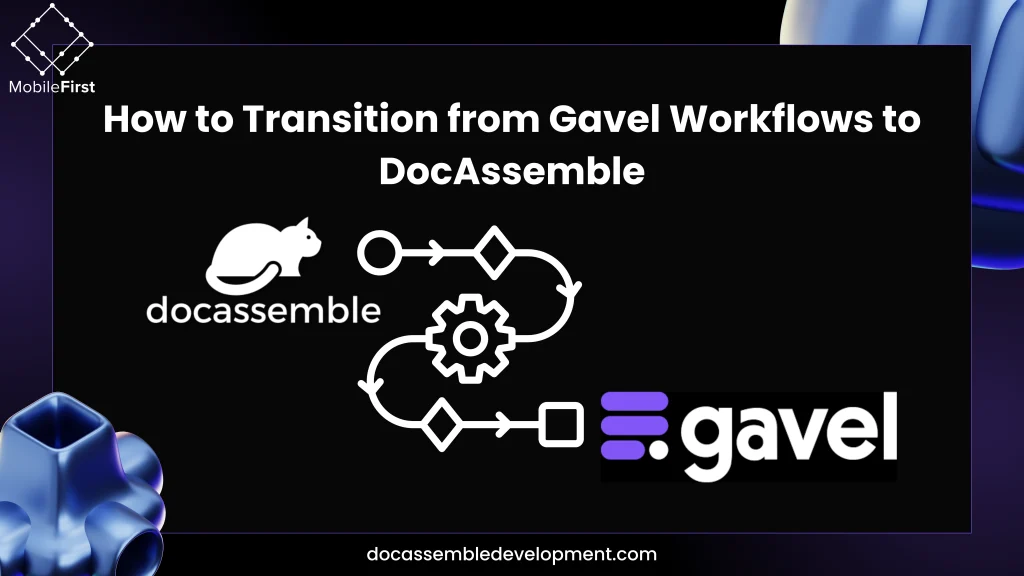
How to Transition from Gavel Workflows to DocAssemble

Introduction Transitioning from one software to another can feel like a daunting task, especially when your workflows are deeply integrated into your business processes. If you’re considering moving from Gavel Workflows to DocAssemble, you’re likely seeking more flexibility, advanced functionality, or simply a solution that better aligns with your needs. The good news? The transition doesn’t have to be overwhelming. By following a structured approach, you can migrate seamlessly, preserve your data integrity, and unlock the full potential of DocAssemble for your business. This guide will walk you through the steps, key considerations, and tips to ensure a smooth transition. Why Transition from Gavel Workflows to DocAssemble? Both Gavel Workflows and DocAssemble are powerful tools for document automation and legal workflows. However, DocAssemble offers unique advantages that may make it the right choice for businesses looking to scale or customize their operations.Gavel Workflows and DocAssemble are both powerful tools for document automation and legal workflows. However, businesses looking to scale, achieve greater customization, or reduce long-term costs may find DocAssemble a better fit. Here’s why: Step-by-Step Guide to Transitioning 1. Evaluate Your Current Workflows Start by auditing your existing workflows in Gavel. Identify: 2. Learn the Basics of DocAssemble Familiarize yourself with DocAssemble’s structure and capabilities. Key components include: 3. Export Data from Gavel Workflows Most platforms allow for exporting templates, data, or workflows. Export your Gavel Workflows data into a universal format, such as CSV or JSON. This ensures compatibility when importing to DocAssemble. 4. Recreate Templates in DocAssemble In DocAssemble, document templates use Jinja2 syntax for variable handling. Start by: 5. Rebuild Logic and Workflow Use DocAssemble’s YAML files to define: 6. Integrate Existing Tools If your Gavel workflows were integrated with third-party apps (e.g., payment processors, CRMs), configure similar integrations in DocAssemble using its API capabilities. This step might require some coding, but it ensures continuity in your processes. 7. Test Extensively Testing is crucial to a successful transition. Run your workflows in the DocAssemble Playground, checking for: 8. Train Your Team Transitioning to a new platform requires buy-in and familiarity from your team. Provide training sessions or resources to ensure everyone is comfortable using DocAssemble. 9. Migrate Live Workflows Once testing is complete, migrate your live workflows to DocAssemble. Monitor their performance closely in the initial stages to address any unexpected issues. 10. Iterate and Optimize DocAssemble’s flexibility allows for continuous improvement. Collect user feedback, identify pain points, and enhance workflows over time to maximize efficiency. Benefits of Moving to DocAssemble Common Challenges and How to Overcome Them 1. Learning Curve Transitioning to DocAssemble can be intimidating, particularly for those new to programming languages like YAML or Python. The platform’s powerful features may feel complex at first. Solution: 2. Data Migration Issues Moving data from your existing systems into DocAssemble can result in errors or inconsistencies, especially if the data isn’t properly formatted or verified beforehand. Solution: 3. Team Resistance Employees might resist adopting new software due to unfamiliarity or fear of disruption to their workflows. This can hinder the platform’s full potential and delay implementation. Solution: Real-Life Example: Transitioning in Action Let’s consider a legal firm that used Gavel Workflows to automate NDA creation. After switching to DocAssemble, they: The transition enabled the firm to offer faster, more personalized services, improving client satisfaction and reducing operational overhead. FAQs 1. Why should I switch from Gavel Workflows to DocAssemble? While Gavel Workflows is user-friendly, DocAssemble provides greater flexibility, customization options, and cost savings, making it ideal for businesses with complex or evolving needs. 2. Do I need programming skills to use DocAssemble? Basic workflows can be created without programming expertise, but advanced customizations often require familiarity with YAML and Python. Training or hiring a developer can bridge this gap. 3. How long does the transition take? The timeline depends on the complexity of your workflows. Simple transitions may take a few weeks, while more intricate setups could require a few months. 4. Can I integrate DocAssemble with my existing tools? Yes! DocAssemble supports integration with various tools through APIs, enabling seamless connections with CRMs, databases, and payment systems. 5. Is DocAssemble suitable for non-legal industries? Absolutely. While popular in the legal sector, DocAssemble is versatile and can be adapted for any industry requiring document automation, such as healthcare, education, and HR. Conclusion Transitioning from Gavel Workflows to DocAssemble opens the door to unparalleled flexibility, scalability, and efficiency. While the process requires planning and effort, the long-term benefits make it a worthwhile investment. By following a structured approach, leveraging community resources, and focusing on team training, your business can make the switch with confidence and unlock the full potential of DocAssemble. Ready to make the move? Start small, test thoroughly, and watch your workflows transform into powerful, customized solutions that grow with your business.

How to Transition from Gavel Workflows to DocAssemble Read More »

Introduction to Docassemble and Its Uses in Legal Automation

Introduction  Legal professionals face mounting pressures to handle increasing caseloads, meet client demands, and deliver cost-effective solutions, all while maintaining accuracy and compliance. This has led to a shift towards automation to streamline processes and free up valuable time. Enter Docassemble, an open-source platform that is becoming a trusted ally in legal automation. In this blog, we’ll explore what Docassemble is, its advantages for legal professionals, and how it’s transforming legal workflows. What Is Docassemble? At its core, Docassemble is an open-source platform designed for creating guided interviews, forms, and workflows that automate legal processes. Built on Python, it enables users to build interactive document-assembly applications and offers customizable templates, making it an ideal choice for automating repetitive tasks in legal practice. Originally developed by legal aid attorney Jonathan Pyle, Docassemble’s goal was to provide a tool that could help create guided interviews and automate document generation for clients who may lack legal expertise. Since then, it has grown into a versatile platform that can be adapted for a range of use cases, from basic forms to complex workflows. Key Features of Docassemble How Docassemble Benefits Legal Professionals Docassemble in Action: Real-World Applications Here’s a look at how legal professionals and firms are using Docassemble to streamline their processes: 1. Client Intake Automation For most law firms, the client intake process is critical but involves time-consuming data gathering and initial screening. With Docassemble, law firms can create client intake forms that gather all relevant information, automatically generating the initial documents needed for a case. 2. Document Generation for Family Law In family law, there’s a vast range of forms and documents to handle. From divorce to custody agreements, these can be time-consuming to draft manually. Docassemble allows attorneys to create automated workflows for family law clients, asking questions that fill out forms with accurate details, resulting in comprehensive, ready-to-file documents. 3. Estate Planning and Wills Estate planning requires gathering extensive information to draft wills, trusts, and power of attorney documents. By using Docassemble, legal professionals can automate the interview process, helping clients answer questions and ensuring their preferences are accurately reflected in the final documents. This approach saves time for both attorneys and clients while enhancing accuracy. 4. Small Business Contracts and Compliance Small business owners often need legal documents like contracts, NDAs, or compliance forms. A law firm can create Docassemble templates that guide small business owners through basic contracts, ensuring all necessary clauses are covered. This saves the business owner legal costs while providing the firm with a streamlined process for handling high-volume, low-cost cases. 5. Public Defender Offices In underfunded public defender offices, attorneys handle heavy caseloads. By automating repetitive processes like client intake or the preparation of certain defense documents, Docassemble frees up attorneys to focus on cases that require personal attention. Implementing Docassemble: Considerations for Law Firms Implementing a tool like Docassemble requires some planning and preparation to ensure it meets your firm’s specific needs. The Future of Docassemble in Legal Automation The legal industry is evolving rapidly, and as more firms turn to automation, Docassemble stands out as a solution built specifically for legal workflows. Its open-source nature makes it adaptable to changing needs, with new features and modules continuously being developed by a growing community of users. Potential Developments: Conclusion Docassemble offers a powerful toolkit for legal professionals seeking to streamline workflows, save time, and reduce costs. By enabling automation in document generation, client intake, and even complex legal processes, Docassemble empowers law firms to deliver better, faster, and more accessible services to clients. The platform’s open-source nature and adaptability make it a versatile choice that’s driving the future of legal automation. For any legal professional, especially those in small or solo practices, embracing tools like Docassemble can be a transformative step toward a more efficient and client-centered practice. As technology continues to reshape the legal field, Docassemble remains at the forefront, helping professionals meet the demands of the modern legal landscape. FAQs 1. What is Docassemble, and how does it work in the legal industry? Docassemble is an open-source platform designed to automate the creation of documents and manage workflows through guided interviews and logic-based decision-making. In the legal industry, Docassemble is used to streamline tasks such as document generation, client intake, and form filling, making these processes faster and more efficient. 2. Do I need programming skills to use Docassemble? Basic programming knowledge, especially in Python, can be helpful for customizing Docassemble, but you don’t need advanced skills to get started. Many templates and guided interviews are available that simplify initial setup, and some firms hire consultants to tailor Docassemble’s features to their specific needs. 3. How does Docassemble improve accuracy and compliance in legal work? Docassemble reduces human error by automatically populating forms and documents based on user responses. By following predetermined logic flows, Docassemble ensures that all required information is included and that the documents meet compliance standards, which is particularly beneficial in highly regulated areas of law. 4. What are the main benefits of using Docassemble for legal professionals? Docassemble saves time on repetitive tasks, enhances accuracy, improves client experience, and enables firms to handle more cases without increasing workload. Additionally, it’s a cost-effective solution that helps firms offer affordable services while maintaining quality. 5. Is Docassemble secure for handling sensitive legal information? Yes, Docassemble can be configured with secure hosting options and encryption to protect client data. Since it’s open-source, legal professionals have control over how the system is deployed and can implement robust security measures to comply with data protection regulations.

Introduction to Docassemble and Its Uses in Legal Automation Read More »

en_USEnglish
Scroll to Top