DocAssemble Development

LegalTech

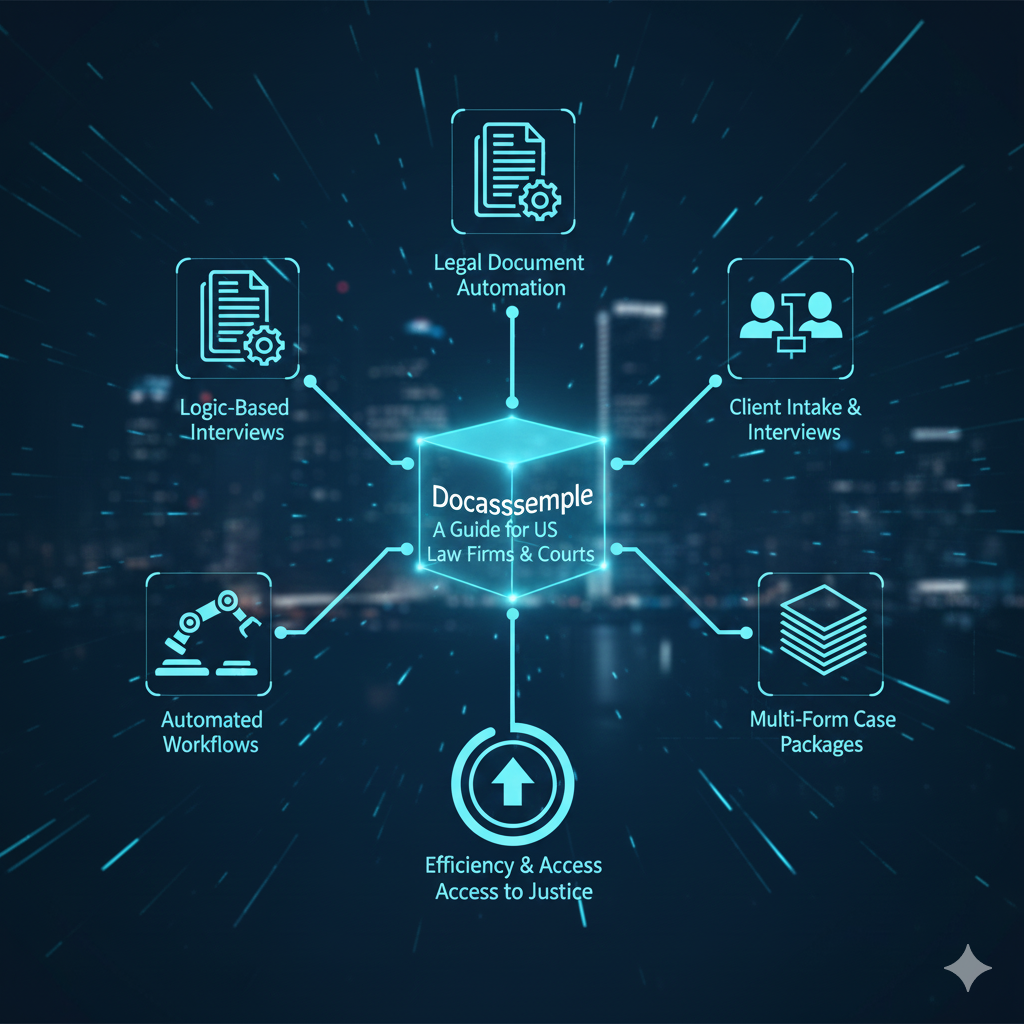
What Is Docassemble? A Guide for US Law Firms & Courts

What Is Docassemble? A Guide for US Law Firms & Courts

Legal professionals in the United States are under constant pressure to do more with less—serve more clients, reduce turnaround time, maintain compliance, and still deliver accurate, high-quality legal documents. Traditional document drafting methods, spreadsheets, and static templates are no longer enough. This is where Docassemble comes in. In this guide, we’ll explain what Docassemble is, how it works, and why Docassemble for law firms and courts is becoming one of the most trusted approaches to modern legal document automation software in the US. What Is Docassemble? Docassemble is an open-source document automation platform designed to create interactive, logic-driven legal interviews that generate documents automatically in formats such as PDF, DOCX, and RTF. Instead of filling out static forms or manually editing templates, users answer guided questions. Based on those answers, Docassemble applies legal logic and generates court-ready documents instantly. At its core, Docassemble combines: This makes it ideal for document automation for law firms, courts, and legal aid organizations. Why US Law Firms & Courts Use Docassemble 1. Automation Without Losing Legal Control Unlike rigid proprietary tools, Docassemble allows attorneys to encode their own legal logic. You control how interviews flow, how documents are assembled, and how edge cases are handled. This flexibility is why Docassemble for law firms is popular among firms that handle: 2. Built for Complex Legal Workflows US legal processes are rarely simple. Docassemble handles: This makes it a powerful alternative to traditional law firm automation tools that struggle with complexity. 3. Open-Source Transparency Docassemble is fully open source. That means: For courts and government-funded legal organizations, this transparency is critical. How Docassemble Works (In Simple Terms) A Docassemble system typically includes: This workflow replaces hours of manual drafting with minutes of guided automation—unlocking true automated legal document generation. A Simple Technical Example (Docassemble Logic) Here’s a simplified example showing how Docassemble uses logic to control document flow: Key Use Cases for Docassemble in the US Legal System Law Firms Courts Legal Aid Organizations All of these rely on legal document automation software that can scale securely. Security & Compliance Considerations Docassemble deployments can be designed to meet strict US legal requirements, including: When implemented correctly, Docassemble meets or exceeds the security posture of many proprietary law firm automation tools. “Docassemble doesn’t replace lawyers—it removes repetitive work so lawyers can focus on judgment, strategy, and client advocacy.” Common Challenges (and How to Solve Them) Off-the-shelf setups don’t fit your workflow Solution: Custom interview and logic design Teams struggle with YAML/Python Solution: Work with experienced Docassemble developers Integrations feel complex Solution: Design APIs and data flows upfront With the right implementation partner, Docassemble becomes a long-term asset—not a technical burden. Final Thoughts Docassemble for law firms is not just another legal tech tool—it’s a platform for building custom, logic-driven legal systems that scale with your practice. For US law firms and courts seeking transparency, flexibility, and long-term control, Docassemble offers a future-proof foundation for document automation for law firms and automated legal document generation. With the right strategy and implementation, Docassemble can transform how legal services are delivered—efficiently, securely, and at scale. FAQ 1. Is Docassemble suitable for small and mid-sized law firms?  Yes. Docassemble works well for small and mid-sized firms because it automates repetitive drafting without forcing you into rigid templates. Firms can start with a few high-impact workflows—like intake or pleadings—and expand over time without expensive licensing fees. 2. Do lawyers need to know how to code to use Docassemble? Not necessarily. End users (lawyers, staff, clients) interact with simple question-and-answer interviews. However, building and maintaining advanced workflows does require technical expertise, which is why many firms work with Docassemble specialists for setup and customization. 3. How is Docassemble different from standard form builders? Unlike basic form builders, Docassemble supports legal logic, conditional flows, multi-document case packets, and jurisdiction-specific rules. This makes it ideal for real-world legal work, not just simple forms or questionnaires. 4. Is Docassemble secure enough for courts and legal aid organizations?  Yes, when implemented correctly. Docassemble can be deployed with strong security controls like encryption, role-based access, audit logs, and secure hosting. Many courts and legal aid organizations in the US already rely on Docassemble for sensitive legal workflows. 5. What types of legal documents are best suited for Docassemble?  Docassemble is ideal for documents that follow structured logic—such as pleadings, motions, immigration forms, family law packets, estate planning documents, and court self-help forms. Any process that repeats with variation is a strong candidate for automation.

What Is Docassemble? A Guide for US Law Firms & Courts Read More »
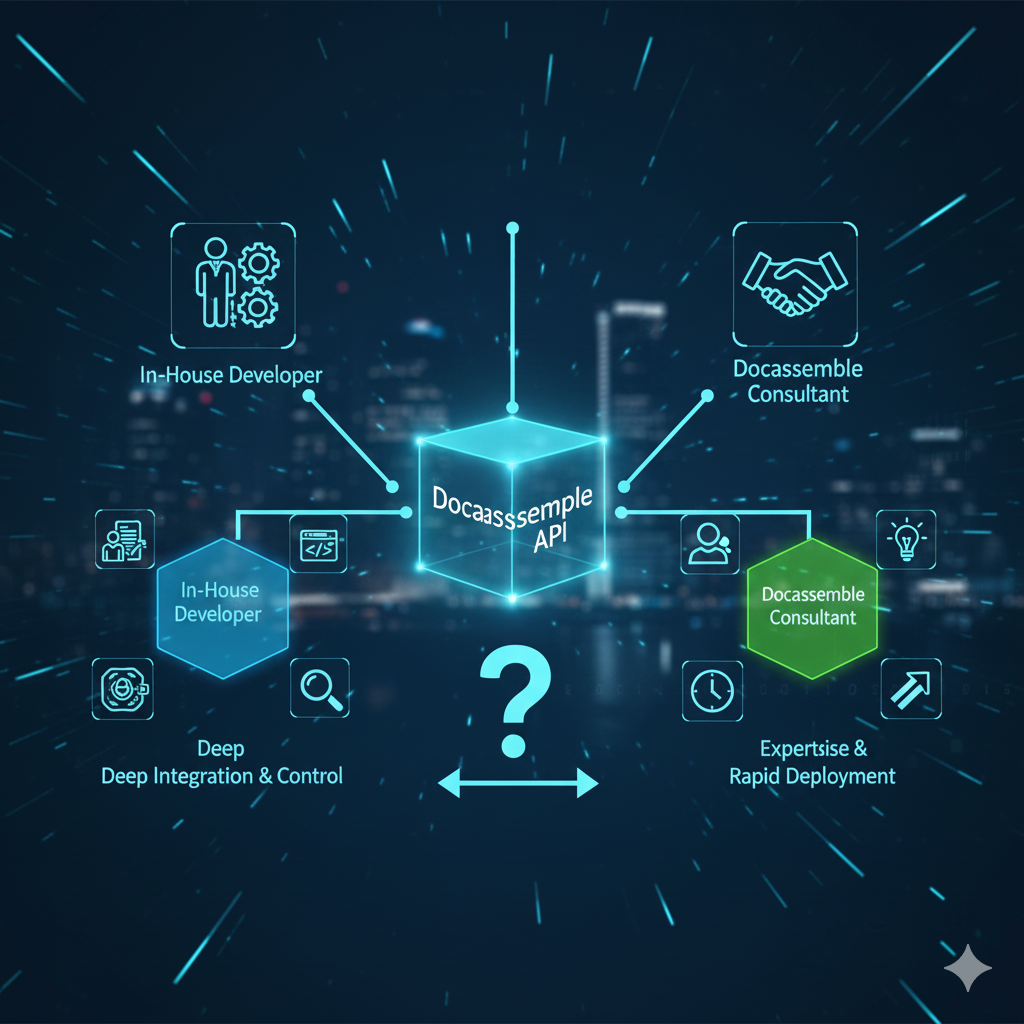
When to Hire a Docassemble Consultant vs In-House Developer: A Practical Guide for Legal Teams

When to Hire a Docassemble Consultant vs In-House Developer: A Practical Guide for Legal Teams

As a legal professional, your team may face the decision of whether to hire an in-house developer or a Docassemble consultant when looking to implement Docassemble for document automation. Docassemble is an open-source platform used to automate legal document creation, but to fully leverage its power, you may require specialized knowledge. Knowing when to hire a Docassemble consultant or an in-house developer can save time, money, and effort. This practical guide will walk you through the factors you should consider when making this decision, helping your legal team make the right choice. What is Docassemble and Why is it Essential for Legal Teams? Docassemble is a robust, open-source document automation platform designed to simplify the creation of legal documents. It helps streamline complex legal workflows, from client intake forms to intricate multi-page case documents. By integrating Docassemble, legal teams can automate repetitive tasks, ensuring consistency and compliance, while saving valuable time. Whether you need to generate contracts, pleadings, or other legal documents, Docassemble provides the tools necessary to complete these tasks efficiently. What Does a Docassemble Consultant Do? A Docassemble consultant is an expert who specializes in implementing, customizing, and maintaining Docassemble solutions. Unlike general developers, Docassemble consultants bring specific knowledge of the platform, ensuring that your legal workflows are streamlined according to best practices. Key Roles of a Docassemble Consultant: When Should You Hire a Docassemble Consultant? While an in-house developer can handle basic coding tasks, hiring a Docassemble consultant is often the right choice when you require deep expertise and efficient setup. Below are scenarios where a Docassemble consultant is the best fit for your team. 1. You Have Complex, Customized Legal Workflows If your legal team requires a high degree of customization—such as automating complex multi-form case packages or creating intricate workflows—hiring a Docassemble consultant can ensure that your platform is built with the right logic and user experience. For example, a Docassemble consultant can help automate document generation for specific legal case types and integrate them into your firm’s existing systems. Example Code Snippet – Automating Complex Document Creation: A Docassemble consultant will not only help with writing these YAML files but will also optimize your setup, ensuring everything functions according to your practice’s workflow. 2. You Need to Integrate Docassemble with Other Tools If you are looking to integrate Docassemble with existing systems such as CRM software, case management platforms, or payment systems, a Docassemble consultant will help make this seamless. A consultant will have experience with the necessary APIs and can ensure that all systems communicate correctly. When Should You Hire an In-House Developer? While a Docassemble consultant is perfect for specific use cases, an in-house developer might be a better option in some situations. Here are some circumstances where an in-house developer might be the better choice. 1. Your Team Needs Long-Term Maintenance If you expect to continuously tweak and update your Docassemble solution, an in-house developer might be more suitable. They will be familiar with your team’s needs, can provide ongoing maintenance and updates, and ensure that the system is aligned with your changing requirements over time. 2. You Have a Team Already Familiar with Docassemble If your in-house team already has some knowledge of Docassemble or similar document automation tools, it might make sense to build your own in-house expertise. In this case, an in-house developer can take ownership of future development, ensuring that changes are made efficiently and according to the team’s specifications. Docassemble Consultant vs In-House Developer: Key Considerations Choosing between hiring a Docassemble consultant or an in-house developer largely depends on the complexity of your requirements and the long-term goals for your firm. Here are some important factors to consider: Factor Docassemble Consultant In-House Developer Expertise Deep expertise in Docassemble and legal automation General coding experience, may lack Docassemble knowledge Customization Needs Perfect for complex workflows and custom legal document automation May be limited to simple integrations or setups Advantages of Hiring a Docassemble Consultant 1. Specialized Knowledge Docassemble consultants are specialists in the platform and understand its intricacies. They are adept at handling complex use cases and can provide tailored solutions that align perfectly with your needs. 2. Faster Implementation Given their expertise, Docassemble consultants can implement and deploy the system quickly, reducing the time needed to set up and start using the platform. 3. Compliance Assurance A Docassemble consultant will ensure that your workflows are legally compliant with industry standards, including data protection regulations like GDPR or other local regulations. Final Thoughts Choosing between a Docassemble consultant and an in-house developer ultimately depends on your firm’s specific needs, available resources, and long-term goals. If you require custom automation and specialized integration, hiring a Docassemble consultant will provide immediate expertise and results. However, if you’re looking for long-term maintenance and have a team with a solid foundation in Docassemble, an in-house developer might be the best choice. At Docassemble, we specialize in Docassemble legal automation and can help guide your firm through the process of selecting the right approach, whether it’s a consultant or in-house developer. Let us help you optimize your legal workflows with Docassemble and ensure your team gets the best results. FAQ 1. When should I hire a Docassemble consultant instead of an in-house developer? Hiring a Docassemble consultant is ideal when you need expert knowledge and specialized skills for complex legal document automation. If your legal team lacks experience with Docassemble or requires advanced customization, a consultant can provide quick, high-quality results. An in-house developer, on the other hand, is better for ongoing maintenance or when your team already has some familiarity with Docassemble. Consultants bring deep expertise for short-term projects, while an in-house developer is suited for long-term, continuous management. 2. What are the main benefits of hiring a Docassemble consultant for my legal team? A Docassemble consultant brings a wealth of experience in Docassemble implementation and customization. They can efficiently set up the platform, create tailored workflows, and integrate it with your existing systems. The major benefits include: 3. Can

When to Hire a Docassemble Consultant vs In-House Developer: A Practical Guide for Legal Teams Read More »

Docassemble for Immigration Practices: Automating Complex, Multi-Form Case Packages

Docassemble for Immigration Practices: Automating Complex, Multi-Form Case Packages

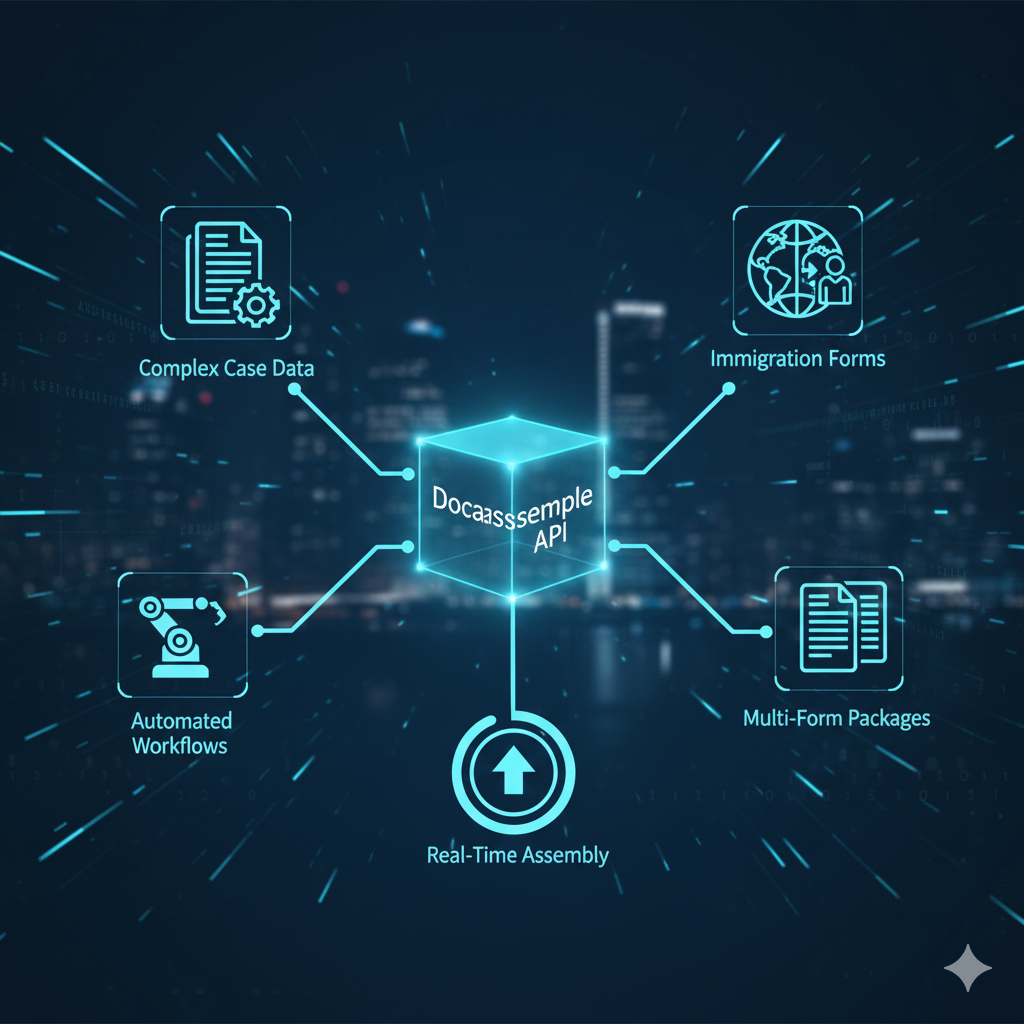
In today’s fast-paced world of immigration law, time is of the essence. Legal professionals handling immigration cases often deal with a large volume of paperwork—forms, documents, and supporting evidence—that must be completed accurately and submitted on time. As the demands on immigration law firms grow, so does the need for an efficient and automated way to handle these processes. That’s where Docassemble immigration automation comes in. Docassemble is a powerful open-source document automation platform that enables law firms and legal practitioners to streamline their immigration practices. By automating complex, multi-form case packages, immigration attorneys can save time, reduce errors, and ensure compliance across all stages of the process. In this blog, we will explore how Docassemble helps immigration practices improve efficiency through immigration document automation and workflow automation. What is Docassemble and How Does It Benefit Immigration Practices? Docassemble is an open-source platform designed to create interactive interviews and automatically generate documents based on user input. It is an ideal tool for immigration legal document automation as it allows for the generation of forms, questionnaires, and supporting documents in formats like PDF, DOCX, and RTF. By automating the creation of complex immigration case packages, Docassemble significantly improves the efficiency and accuracy of legal workflows. For immigration attorneys, Docassemble’s ability to automate multi-form case packages is a game changer. With just a few clicks, attorneys can create complete case files with all necessary forms and documents, reducing the time spent on manual data entry and minimizing the risk of human error. Additionally, Docassemble immigration automation ensures that all documents are compliant with immigration regulations and up-to-date with the latest legal requirements. Benefits of Docassemble Immigration Automation 1. Automate Complex Immigration Forms One of the most significant challenges faced by immigration professionals is handling the complex paperwork involved in each case. Immigration cases require numerous forms, such as visa applications, petition forms, and supporting documentation. With Docassemble, this process becomes a breeze. For instance, Docassemble immigration forms can be automatically generated based on a client’s responses to an interactive interview. The platform dynamically fills in required fields, ensuring that every form is correctly completed based on the individual’s case.Here’s an example of an automated Docassemble immigration form generation workflow: In the above example, as the user progresses through the interview, their responses will automatically populate the corresponding fields in the visa application form. “By automating the generation of multi-form case packages, Docassemble empowers immigration practices to streamline complex workflows, reduce errors, and enhance efficiency, allowing legal professionals to focus on what matters most—serving their clients.” 2. Streamlined Workflow Automation Managing multiple clients and their documents can be cumbersome, especially when dealing with large volumes of data. With Docassemble immigration workflow automation, all your case management processes can be automated. This includes generating documents, managing case timelines, sending reminders, and even creating custom workflows for different types of cases (e.g., work visas, family reunification, etc.). For example, after an immigration interview, Docassemble can automatically trigger the generation of case-specific forms, and it can even send out email reminders to clients with document submission instructions or next steps. This level of workflow automation not only saves time but also ensures consistency and reduces the chance of missed deadlines. 3. Improved Accuracy and Compliance In immigration law, compliance is critical. Automated visa application processing with Docassemble ensures that all forms and documents are filled out accurately, based on the most current regulations and guidelines. Moreover, Docassemble automatically checks for missing or incomplete information, flagging issues before documents are submitted. By incorporating legal rules into the interview logic, Docassemble can dynamically adjust the flow of questions, ensuring that users are only asked relevant questions for their particular immigration case. This reduces errors and ensures that the generated documents meet the required legal standards. 4. Seamless Integration with Other Tools Docassemble can easily integrate with CRM systems, document management tools, and even custom databases, allowing you to centralize your operations. For example, you can integrate Docassemble with a client management system, automatically populating client information into forms or updating case statuses without manual intervention. This ensures that all the data is up-to-date and secure. Implementing Docassemble in Your Immigration Practice Step 1: Set Up the Docassemble Platform To begin, you’ll need to install Docassemble on your server or use a cloud-based platform. While Docassemble can be hosted on your local machines, many law firms prefer cloud solutions for easier access and better scalability. The platform is open-source, and there are plenty of community resources to help you get started. Step 2: Create Custom Immigration Questionnaires Once Docassemble is set up, you can start building your custom immigration questionnaires. You can define which fields need to be filled, the types of questions (e.g., text input, multiple-choice), and the corresponding immigration forms for each case type. For example, if you’re dealing with a work visa case, your interview could include questions about the applicant’s employment status, job title, and employer details, all of which will then be used to auto-generate the visa application form. Step 3: Integrate Docassemble with Your Practice’s Workflow After setting up your questionnaires, it’s time to integrate Docassemble into your practice’s daily workflow. This includes automating the document creation process, sending reminders to clients, and tracking case progress. You can even generate automatic emails to notify clients of updates or when their documents are ready for review. Step 4: Monitor and Improve the Workflow As with any software implementation, continuous monitoring is key to optimizing the system. Regularly track your automated workflows to ensure everything is running smoothly, and collect feedback from your team to make improvements. Over time, you can add new questions, update documents based on legal changes, and further customize the system to meet your firm’s unique needs. Why Choose Docassemble Immigration Automation? 1. Efficiency Automating the generation of immigration documents reduces the time it takes to handle complex cases and minimizes human errors, which could lead to costly delays or rework. 2. Scalability As your firm grows, Docassemble immigration automation

Docassemble for Immigration Practices: Automating Complex, Multi-Form Case Packages Read More »

How to Budget a Docassemble Project: Timelines, Costs, and Common Pitfalls for US Firms

How to Budget a Docassemble Project: Timelines, Costs, and Common Pitfalls for US Firms

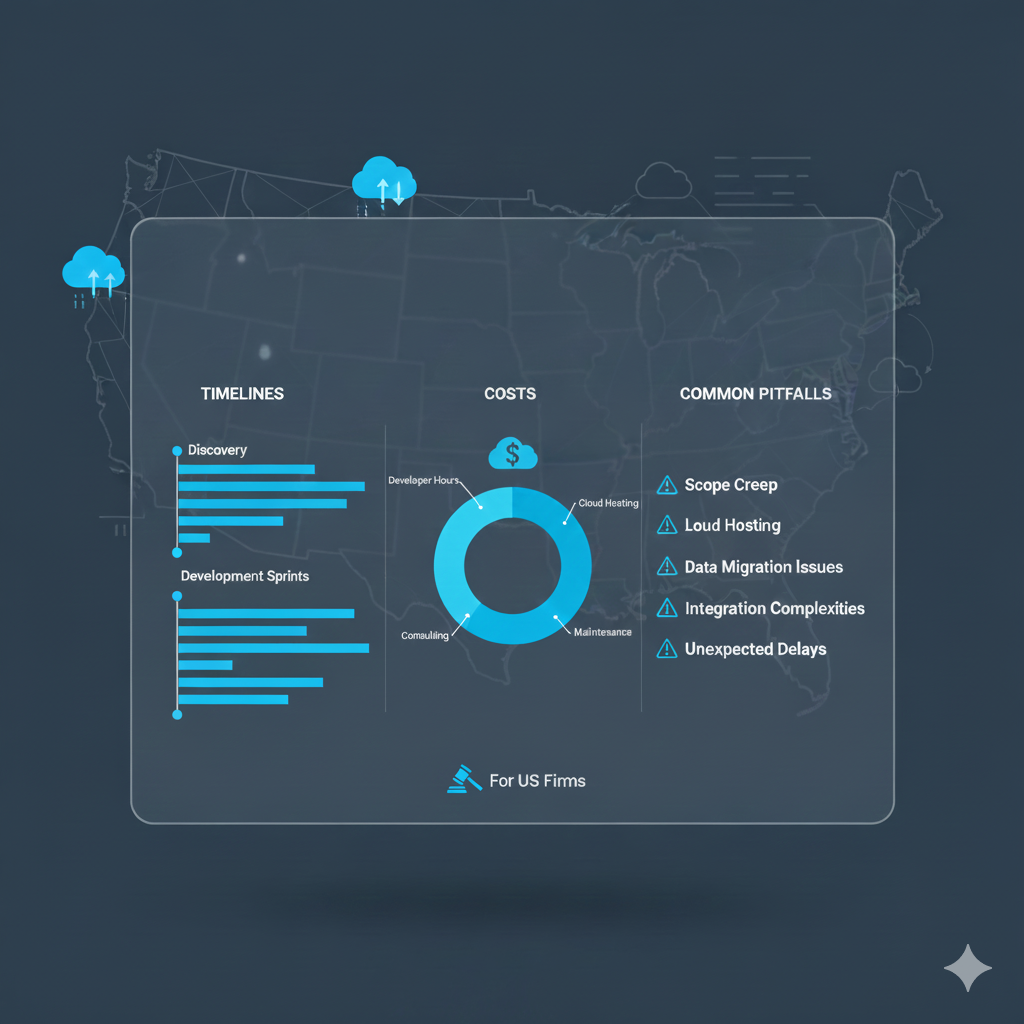
Docassemble has become one of the most powerful platforms for legal document automation in the US. Courts, legal aid organizations, and private law firms rely on it to reduce drafting time, improve accuracy, and expand access to justice. But while Docassemble itself is open source, planning the real cost of a Docassemble project is where many US firms struggle. This guide breaks down what actually goes into a Docassemble budget—from timelines and scope to hidden pitfalls—so you can plan realistically and avoid surprises. We’ll also explain what truly drives docassemble development cost in real-world legal environments. Why Budgeting a Docassemble Project Is Different Unlike off-the-shelf legal document automation software, Docassemble is a development platform, not a plug-and-play product. That’s its biggest strength—and the main reason budgeting requires careful thinking. A Docassemble project typically involves: This means budgeting is less about licenses and more about design, development, and long-term ownership. Key Factors That Influence Docassemble Development Cost Let’s start with the biggest drivers. 1. Complexity of Legal Logic A simple intake form costs far less than a system that: The more complex the logic, the higher the docassemble development cost. 2. Number and Type of Documents Costs scale with: Projects involving automated legal document generation for court-ready filings require more testing and refinement. 3. Jurisdictional Requirements State-specific automation (for example, Florida legal forms automation) often increases scope due to: Jurisdictional nuance is one of the most underestimated budget factors. 4. User Roles and Workflows Single-user tools cost less than systems built for: Projects that support collaboration fall under true document automation for law firms, which requires additional planning. Typical Timelines for US Docassemble Projects While every project is different, most US firms fall into one of these ranges: Small Projects (4–6 weeks) Medium Projects (8–12 weeks) Large Projects (3–6+ months) Timelines directly affect docassemble development cost, especially when scope is unclear at the start. Cost Ranges You Should Expect (US Market) While exact numbers vary, realistic US ranges look like this: These costs reflect real development effort—not just setup—unlike generic legal document automation software subscriptions. Common Budgeting Pitfalls US Firms Should Avoid 1. Treating Docassemble Like a Form Builder Docassemble is not a drag-and-drop tool. Underestimating this leads to blown budgets and missed deadlines.  2. Skipping Discovery Firms that rush straight into development often: Clear discovery reduces docassemble development cost significantly. 3. Ignoring Hosting and Maintenance Budgeting only for build—and not for: —creates problems after launch. 4. Over-Automating Too Early Trying to automate everything at once often backfires. Phased delivery usually costs less and delivers value faster. A Smarter Way to Budget: Phased Automation Successful US firms budget Docassemble projects in phases: This approach controls docassemble development cost while delivering early wins. Build vs Buy: Why Docassemble Still Wins Compared to traditional legal document automation software, Docassemble offers: For firms serious about automated legal document generation, long-term ROI often favors Docassemble—when budgeted correctly. Budgeting for Long-Term Success A well-budgeted Docassemble project: That’s why more firms are shifting from generic tools to document automation for law firms built on Docassemble. Final Thoughts Budgeting a Docassemble project isn’t about finding the cheapest option—it’s about aligning scope, timelines, and legal reality. When planned correctly, docassemble development cost becomes an investment that pays off in: If your US firm is considering Docassemble, the smartest first step is a clear, honest budget plan. FAQ 1. How much does a typical Docassemble project cost for a US law firm? Most US firms spend anywhere from $10,000 to $50,000 depending on scope. Simple intake and a few documents cost less, while multi-practice or court-ready systems cost more. The biggest cost driver isn’t Docassemble itself—it’s the legal logic, testing, and long-term usability of the system. 2. Why do Docassemble budgets vary so much between firms? Every firm’s workflows are different. Costs change based on how many documents you automate, how complex the legal rules are, whether the system is jurisdiction-specific, and how many users need access. Two firms using Docassemble can have very different budgets because their legal realities aren’t the same. 3. How long does it usually take to build a Docassemble system? Most projects take 4 to 12 weeks for core functionality. Larger systems with multiple documents, practice areas, or users can take several months. Teams that invest time in planning and discovery usually finish faster—and with fewer revisions—than those who rush into development. 4. What are the most common budgeting mistakes firms make? The biggest mistake is treating Docassemble like a simple form builder. Other common issues include skipping discovery, trying to automate everything at once, and forgetting to budget for hosting and ongoing updates. These shortcuts often lead to higher costs later. 5. Is it better to start small or build everything at once? Starting small almost always works better. Many successful firms begin with one high-impact workflow, see real results, and then expand. This phased approach reduces risk, controls costs, and ensures the system evolves based on real attorney feedback.

How to Budget a Docassemble Project: Timelines, Costs, and Common Pitfalls for US Firms Read More »

Building an End-to-End Document Assembly System for Florida Attorneys

Building an End-to-End Document Assembly System for Florida Attorneys (PleadingPower Story)

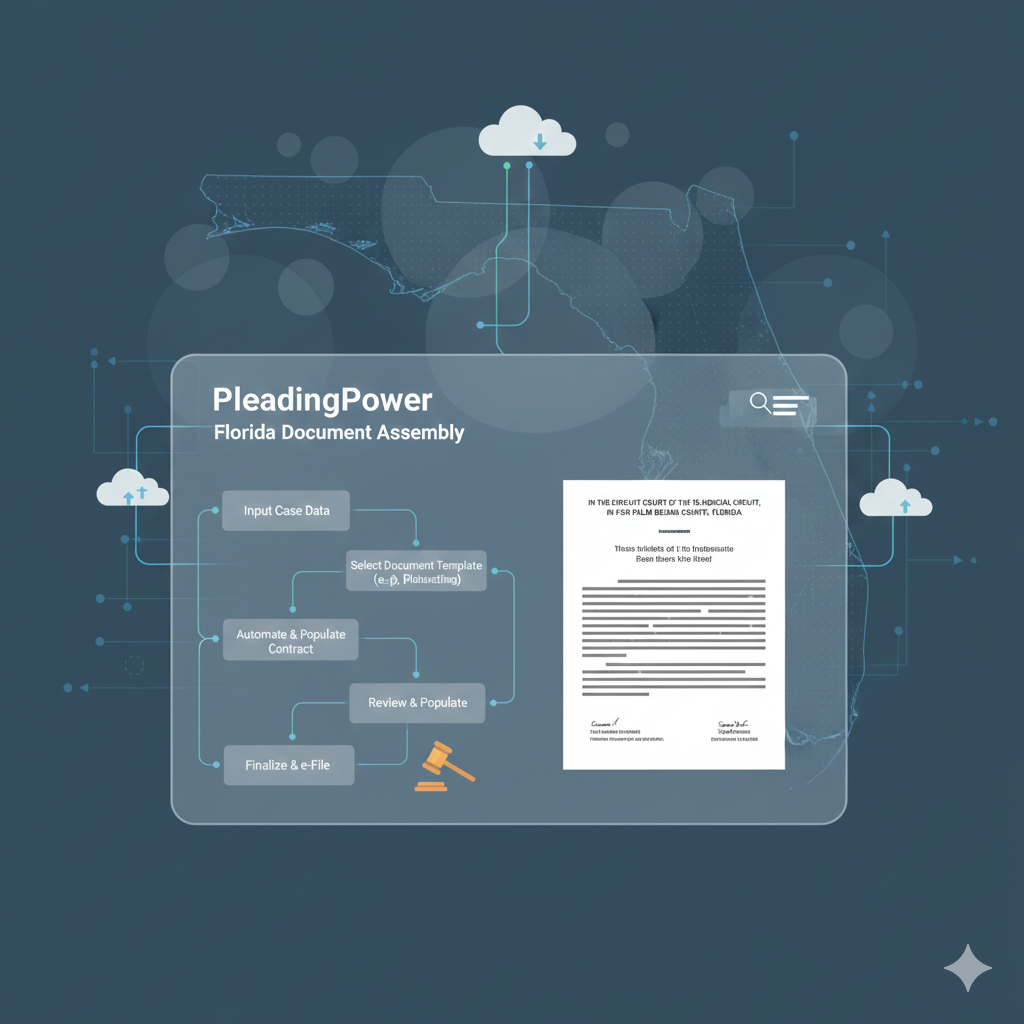
Florida attorneys operate in one of the most document-intensive legal environments in the United States. From civil pleadings and motions to family law filings and court-specific forms, lawyers face relentless drafting pressure—often under tight deadlines and strict formatting rules.This is the story of how PleadingPower was built as an end-to-end document assembly system using Docassemble—and how florida legal document automation docassemble became the backbone for scalable, attorney-grade automation. The Real Problem Florida Attorneys Face Florida law firms aren’t short on templates. They’re short on time, consistency, and reliability. Common challenges we heard repeatedly: Traditional legal document automation software helped somewhat—but most tools stopped at static templates. Florida attorneys needed logic-driven automation, not just mail-merge. Why Docassemble Was the Right Foundation Docassemble stood out because it wasn’t just a form builder—it was a legal automation engine. What made it ideal for PleadingPower: This aligned perfectly with docassemble legal automation goals: build once, adapt endlessly. Designing an End-to-End System (Not Just a Tool) From day one, PleadingPower was designed as a system, not a standalone feature. Core Design Principles This ensured the platform truly supported document automation for law firms, not just tech demos. Step 1: Mapping Florida-Specific Legal Logic Florida courts have unique procedural rules. Automating them required more than fields and checkboxes. Examples: Docassemble’s logic engine allowed us to encode these nuances directly into interviews—creating florida legal forms automation that attorneys could trust. Step 2: Building Intelligent Legal Interviews Instead of asking users to “fill a form,” PleadingPower guides attorneys through legal decision-making. The interviews: This approach dramatically reduced errors and review cycles—unlocking true automated legal document generation. Step 3: Document Assembly at Production Quality Every generated document needed to be: Docassemble templates were structured to: This transformed automation from “draft assistance” into final-document creation. Technical Snapshot: How Docassemble Powers It Below is a simplified conceptual example showing how conditional logic drives document assembly. Step 4: Multi-User & Practice-Wide Deployment PleadingPower wasn’t built for a single attorney—it was built for entire firms. Key considerations: This is where Docassemble shines for document automation for law firms at scale. Step 5: Security, Compliance, and Trust Florida attorneys handle sensitive client data. Security was non-negotiable. Implemented safeguards included: These practices aligned with best-in-class legal document automation software expectations. Outcomes: What Changed for Florida Attorneys After deploying PleadingPower, attorneys reported: Automation didn’t replace legal thinking—it amplified it. Why Generic Tools Fall Short in Florida Many off-the-shelf tools promise automation but fail in real legal environments because they: That’s why docassemble legal automation remains the preferred approach for serious legal systems. Why This Model Works Beyond Florida While PleadingPower was built for Florida, the architecture is adaptable: That’s the power of automated legal document generation done right. Final Thoughts PleadingPower proves a simple truth:Legal automation succeeds when it respects legal reality. By combining: We delivered a platform that goes beyond drafting—to operational transformation. If you’re exploring florida legal document automation docassemble, the lesson is clear:Build systems, not shortcuts. FAQ 1. Why did Florida attorneys need a custom document assembly system like PleadingPower? Florida attorneys deal with strict court rules, county-specific formatting, and high document volumes. Generic templates often fall short. PleadingPower was built to reflect how Florida lawyers actually work, embedding local rules and legal logic so documents are accurate, consistent, and ready to file—without constant rework. 2. How is this different from using Word templates or basic automation tools? Word templates save time on formatting, but they don’t think. PleadingPower uses intelligent interviews and conditional logic to adapt documents based on the case, jurisdiction, and attorney choices. That means fewer errors, less manual review, and documents that change correctly as facts change. 3. Do attorneys need technical skills to use a Docassemble-based system? No. One of the core goals was simplicity. Attorneys answer guided questions—much like talking through a case with a colleague—and the system handles the logic behind the scenes. The technology stays invisible, letting lawyers focus on legal judgment, not software. 4. Is a system like PleadingPower secure enough for sensitive Florida legal matters? Yes, when deployed properly. PleadingPower was designed with secure hosting, encrypted data transmission, controlled access, and audit-friendly workflows. Security was treated as a foundational requirement, not an afterthought, which is critical for client confidentiality and professional responsibility. 5. Can this approach be adapted for other Florida practice areas or states? Absolutely. While PleadingPower was built for Florida attorneys, the underlying Docassemble architecture is reusable. New practice areas, additional Florida courts, or even other states can be supported by extending the logic—without rebuilding the system from scratch.

Building an End-to-End Document Assembly System for Florida Attorneys (PleadingPower Story) Read More »

How to Integrate Docassemble with Salesforce, LegalServer, and Custom CRMs

How to Integrate Docassemble with Salesforce, LegalServer, and Custom CRMs

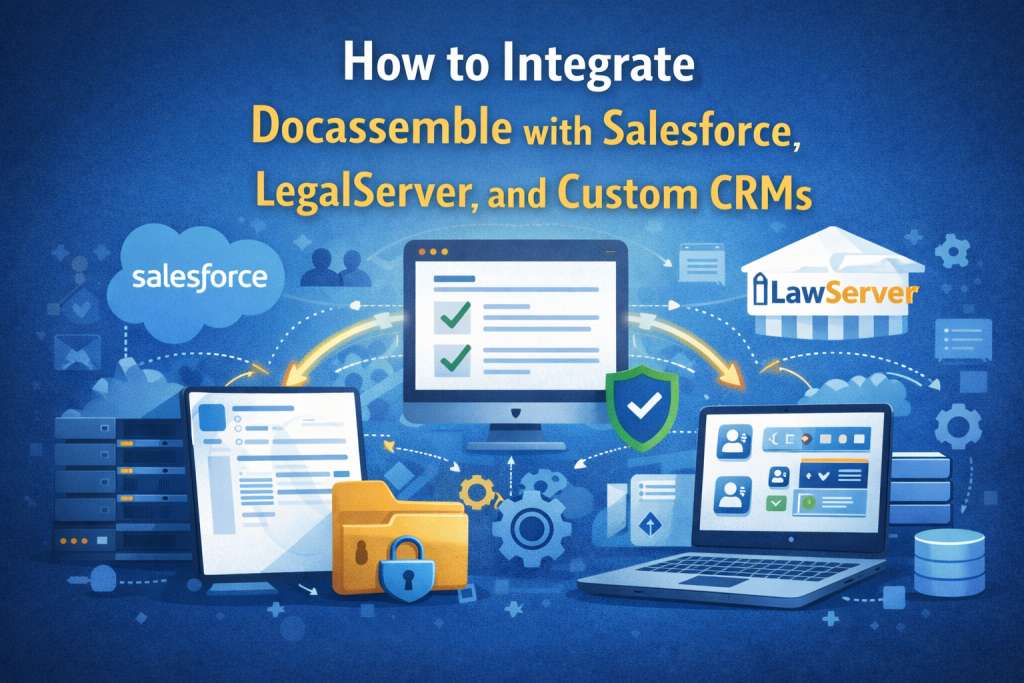
Docassemble powers intelligent legal interviews and document generation. CRMs like Salesforce and LegalServer manage clients, cases, and workflows. When these systems operate in silos, staff end up re-entering data, copying documents manually, and chasing updates across platforms. That’s why docassemble crm integration has become a priority for modern law firms and legal aid organizations. This guide walks through how to integrate Docassemble with Salesforce, LegalServer, and custom CRMs—covering architecture, data flows, security considerations, and real-world implementation patterns. Why CRM Integration Matters in Legal Automation Docassemble excels at: CRMs excel at: Without integration, teams face: A well-designed docassemble crm integration turns interviews into live, connected workflows instead of isolated forms. Common Integration Use Cases Before diving into APIs, it’s important to understand why teams integrate Docassemble with CRMs. 1. Automated Legal Intake Use Docassemble interviews to collect client information, then push structured data directly into CRM records. This is the foundation of automate legal intake with Salesforce and similar systems. 2. Case Creation & Updates Automatically create or update cases when interviews are completed or documents are generated. 3. Document Sync Generated PDFs, DOCX, or RTF files are automatically attached to CRM case records. 4. Status & Workflow Triggers CRM status changes can trigger follow-up interviews or document updates in Docassemble. Integration Architecture: The Big Picture At a high level, most integrations follow this pattern: The key design decision is who initiates the data flow: Integrating Docassemble with Salesforce Why Salesforce Is Popular in Legal Ops Salesforce is widely used for legal intake, matter tracking, and reporting—especially in firms and in-house legal teams. That’s why docassemble salesforce integration is one of the most requested setups. Common Salesforce Objects Used Typical Integration Flow This enables salesforce legal case management integration without manual intervention. Integrating Docassemble with LegalServer Why LegalServer Is Different LegalServer is purpose-built for legal aid organizations. Its workflows, permissions, and reporting are tightly aligned with grant and compliance requirements. That’s why legalserver api integration must be handled carefully. Common LegalServer Use Cases Key Consideration LegalServer APIs are powerful but structured. Mapping Docassemble interview variables to LegalServer fields requires: Integrating with Custom CRMs Not every organization uses Salesforce or LegalServer. Many courts and firms rely on: In these cases, docassemble crm integration usually relies on: The principles remain the same: clear data contracts, authentication, and validation. Data Mapping: The Most Critical Step Most integration failures happen here—not in the API calls. Best practices: For example: Security & Compliance Considerations Legal data is sensitive. Your integration must address: Security is especially critical when integrating with CRMs that store long-lived case records. Handling Bi-Directional Sync (Advanced) Some organizations want: This is powerful—but complex. Best practices: Bi-directional docassemble crm integration should be approached deliberately. Common Mistakes to Avoid From real-world projects, the most common pitfalls are: Avoiding these saves months of rework. Why Work with a Docassemble Integration Specialist? Docassemble is flexible—but that flexibility requires expertise. A specialist team helps you: This is especially important for automate legal intake with Salesforce and grant-funded LegalServer deployments. Final Thoughts Docassemble interviews are only as powerful as what happens after the user clicks submit. When connected properly, docassemble crm integration transforms: Whether you’re integrating with Salesforce, LegalServer, or a custom CRM, the goal is the same: less manual work, better data, and faster legal outcomes. FAQ 1. Do we need a CRM to integrate with Docassemble, or can it work on its own? Docassemble works perfectly well on its own for interviews and document generation. However, when you integrate it with a CRM, you unlock much more value—client data flows automatically, cases are created without manual entry, and documents stay attached to the right records. For teams handling high volumes or multiple staff, CRM integration quickly becomes a productivity multiplier. 2. What’s the difference between integrating Docassemble with Salesforce vs LegalServer? Salesforce is a flexible, general-purpose CRM often used for intake and case tracking, while LegalServer is designed specifically for legal aid workflows and compliance reporting. Docassemble integrates with both, but the approach differs—Salesforce integrations focus on custom objects and automation, while LegalServer integrations require careful alignment with program rules and field structures. 3. Is Docassemble CRM integration secure for sensitive legal data? Yes—when implemented correctly. Secure integrations use encrypted connections, authenticated APIs, role-based access, and audit logging. It’s also important to limit what data is shared and ensure users understand how their information will be used. Security and confidentiality should always be part of the integration design, not added later. 4. Can Docassemble push data to our CRM automatically after an interview is completed? Absolutely. This is one of the most common use cases. Once a user completes an interview, Docassemble can automatically send structured data and generated documents to Salesforce, LegalServer, or a custom CRM—creating or updating records without staff involvement. 5. What if we use a custom or in-house CRM instead of Salesforce or LegalServer? Docassemble can integrate with custom CRMs as long as they expose APIs or secure endpoints. The process involves defining data fields, setting up authentication, and testing workflows carefully. Many courts and law firms use this approach to modernize existing systems without replacing them.

How to Integrate Docassemble with Salesforce, LegalServer, and Custom CRMs Read More »

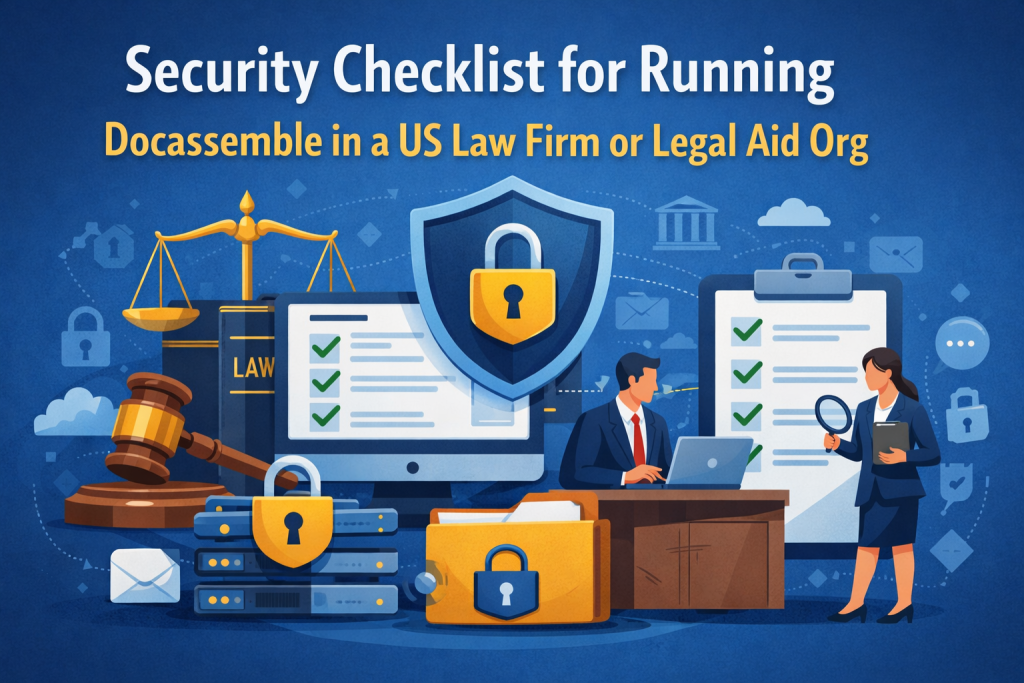
Security Checklist for Running Docassemble in a US Law Firm or Legal Aid Org

Security Checklist for Running Docassemble in a US Law Firm or Legal Aid Org

Legal document automation delivers enormous efficiency gains—but it also introduces serious security responsibilities. When you run Docassemble in a U.S. law firm or legal aid organization, you’re not just hosting a web application. You’re safeguarding confidential client data, privileged communications, and court-ready legal documents. This is why docassemble security best practices aren’t optional. They’re foundational. This guide provides a practical, real-world security checklist for organizations using Docassemble—covering infrastructure, application security, access control, data protection, and operational safeguards. Why Security Matters More in Legal Automation Legal organizations handle some of the most sensitive data possible: A single misconfiguration can expose thousands of interviews and documents. That’s why document automation security must be treated as a first-class concern—not an afterthought. Docassemble is powerful and flexible, but like all open-source platforms, security depends on how it’s deployed and managed. 1. Secure Your Hosting Environment First Your security posture starts below Docassemble—at the infrastructure level. Checklist: This aligns with best practices for open source legal tech security, where infrastructure missteps are the most common attack vector. 2. Enforce HTTPS Everywhere (No Exceptions) All Docassemble traffic must be encrypted in transit. Checklist: Without this, user answers—including SSNs and financial data—can be intercepted. 3. Lock Down Admin and Developer Access Docassemble’s admin interface is powerful—and dangerous if exposed. Checklist: Strong role separation is a core element of docassemble security and is often overlooked in early deployments. 4. Apply Flask Application Security Best Practices Under the hood, Docassemble is a Python/Flask application. That means it inherits both Flask’s flexibility and its risks. Your flask application security checklist should include: These steps align with broader python web app security best practices, which are essential in legal environments. 5. Protect Interview Data and Generated Documents Docassemble stores: Checklist: Good document automation security means knowing exactly where sensitive data lives—and who can access it. 6. Harden Authentication and User Sessions Public-facing legal interviews attract abuse attempts. Checklist: These controls reduce the risk of automated attacks, credential stuffing, and session hijacking. 7. Secure File Uploads and Attachments Many Docassemble workflows allow users to upload documents. Checklist: File handling is one of the most common vulnerabilities in legal automation systems. 8. Log Everything (But Log Safely) Logging is critical for incident response—but logs can become a liability if mishandled. Checklist: This balance is essential for open source legal tech security in regulated environments. 9. Secure Integrations and External Services Docassemble often integrates with: Checklist: Third-party integrations are a growing attack surface. 10. Apply Least-Privilege Database Access Your database should not be a shared free-for-all. Checklist: This is a core requirement in any serious docassemble security best practices program. 12. Prepare for Audits, Not Just Attacks Law firms and legal aid orgs increasingly face: Checklist: Security that can’t be explained often fails audits—even if it works technically. Secure Your Docassemble Deployment with Expert GuidanceContact US Common Docassemble Security Mistakes to Avoid From real deployments, the most common failures include: Docassemble is infrastructure—not a plugin. Why Security-First Docassemble Deployments Win Security-first deployments: Strong docassemble security best practices don’t slow you down—they protect your mission. Final Thoughts Docassemble gives legal organizations incredible power—but with that power comes responsibility. Security isn’t a one-time checklist. It’s an ongoing discipline that combines infrastructure, application design, and operational maturity. If you’re running Docassemble in a U.S. law firm or legal aid organization, following these docassemble security best practices will help ensure your platform is not just functional—but trustworthy, compliant, and resilient. FAQ 1. Is Docassemble secure enough for handling sensitive legal client data? Yes—when it’s configured correctly. Docassemble is a powerful, open-source platform used by courts and legal aid organizations worldwide, but its security depends on how it’s deployed and managed. With proper hosting, encryption, access controls, and ongoing maintenance, Docassemble can meet the high security expectations of U.S. law firms and legal aid organizations. 2. What are the biggest security risks when running Docassemble? The most common risks don’t come from Docassemble itself, but from misconfiguration. These include exposed admin access, weak passwords, missing HTTPS, poor server hardening, or storing sensitive data without encryption. Following a clear security checklist helps prevent these avoidable issues before they become serious problems. 3. Do we need a dedicated IT or security team to run Docassemble safely? Not necessarily, but you do need clear ownership and expertise. Many legal organizations work with a Docassemble specialist or managed services partner to handle security reviews, updates, and monitoring. This approach is common for legal aid orgs and smaller firms that don’t have in-house DevOps or security teams. 4. How does Docassemble help with compliance and audits? When properly configured, Docassemble supports audit readiness through access logs, role-based permissions, and controlled data handling. While Docassemble itself isn’t a compliance certification, it can be deployed in a way that aligns with legal, grant, and court IT security requirements—provided security practices are documented and consistently followed. 5. How often should Docassemble security be reviewed or updated? Security should be treated as an ongoing process, not a one-time setup. Best practice is to review security settings during major updates, after infrastructure changes, and at least annually. Regular patching, access reviews, and security checks help ensure your Docassemble deployment stays safe as threats and requirements evolve.

Security Checklist for Running Docassemble in a US Law Firm or Legal Aid Org Read More »

Docassemble vs Low-Code Form Builders: When Do You Need a Specialist Development Team?

Legal teams today are under pressure to move faster, reduce costs, and deliver consistent outcomes—without compromising accuracy or compliance. That’s why document automation has become a core part of modern legal operations. But once you start exploring automation, a critical question quickly comes up: Should you use a low-code form builder—or invest in Docassemble with a specialist development team? At first glance, both may look like they solve the same problem. In reality, they are built for very different levels of complexity, scale, and legal responsibility. This guide breaks down the difference clearly—so you can make the right decision for your use case. The Rise of Low-Code Form Builders in Legal Teams Low-code and no-code form builder software has exploded in popularity over the last few years. Tools like Jotform, Typeform, Google Forms, and similar form automation tools are attractive because they promise: For basic workflows—intake questionnaires, simple surveys, or static data collection—these tools absolutely have their place. For example: If your requirement stops there, a form builder may be more than enough. But legal workflows rarely stay simple for long. Where Low-Code Form Builders Start to Break Down The moment your workflow involves logic, rules, legal calculations, or jurisdiction-specific conditions, most form builders start showing their limits. Common challenges include: This is where many legal teams realize that a form is not the same as a legal automation platform. And this is where Docassemble comes in. What Makes Docassemble Fundamentally Different? Docassemble is not just another form tool. It is a full-fledged legal automation platform built specifically for complex, rules-driven workflows. At its core, Docassemble allows you to: Unlike drag-and-drop builders, Docassemble behaves more like a programmable system—designed for real legal work, not just data collection. Docassemble vs Form Builders: A Practical Comparison Here’s a real-world comparison that legal teams immediately relate to: Use Case: Divorce Petition Automation With a form builder: With Docassemble: This is why the debate around docassemble developer vs form builder is not about preference—it’s about capability. When a Form Builder Is Enough Let’s be clear—there are scenarios where a form builder is the right choice: If the output is just data—not legally enforceable documents—low-code tools can save time and money. When You Need a Docassemble Specialist Development Team Now let’s talk about the turning point—when DIY tools stop working. You need a docassemble developer or specialist team when your automation involves: 1. Complex Legal Logic If your workflow depends on statutes, thresholds, exceptions, or jurisdiction-specific rules, Docassemble’s Python-based logic is essential. 2. True Document Assembly Docassemble is purpose-built for document assembly tools, not just form submission. Documents adapt dynamically based on answers—not templates with placeholders. 3. Multi-User & Role-Based Workflows Court staff, attorneys, clients, reviewers—each can have different permissions and paths in a Docassemble interview. 4. Compliance, Accuracy & Risk Reduction Legal automation isn’t forgiving. A missed condition can invalidate a document. Specialist teams ensure your logic is tested, reliable, and compliant. 5. Scalability & Long-Term Maintenance What works for 10 users may fail at 10,000. A specialist team builds with scale, hosting, security, and updates in mind. This is the real difference in the docassemble developer vs form builder conversation. A Quick Technical Look: Why Docassemble Is More Powerful Here’s a simplified example that shows why Docassemble goes far beyond form builders. This kind of rule-driven logic—based on real legal requirements—is almost impossible to implement safely in generic form automation tools. Docassemble lets you combine: That’s why it’s trusted by courts, legal aid organizations, and law firms worldwide. The Hidden Cost of “Quick” Form Builders Many teams start with low-code tools to save money—but end up paying more later. Common issues we see: In contrast, investing early in a proper legal automation platform like Docassemble—built by specialists—creates long-term savings, reliability, and confidence. Choosing the Right Path for Your Organization Ask yourself these questions: If the answer is “yes” to any of the above, a form builder is likely a temporary fix—not a solution. Why Work With a Specialist Docassemble Development Team? Docassemble is powerful—but that power comes from correct architecture, clean logic, and deep legal understanding. A specialist team brings: This is not just development—it’s legal systems engineering. Final Thoughts Low-code form builders are great for simple tasks. But when legal accuracy, logic, and document integrity matter, they fall short. The choice between docassemble developer vs form builder is ultimately about seriousness of use. If you’re automating real legal work, Docassemble—built by specialists—is not overkill. It’s the right tool for the job. FAQ 1. Is Docassemble harder to use than a low-code form builder? At first glance, yes—Docassemble does have a learning curve compared to drag-and-drop form builders. But that’s because it’s designed to handle real legal logic, not just collect answers. While form builders focus on ease, Docassemble focuses on accuracy, rules, and outcomes. With a specialist development team, most of the complexity stays behind the scenes, and end users get a smooth, guided experience. 2. When does a form builder stop being enough for legal workflows? A form builder usually falls short when your workflow includes conditional legal rules, jurisdiction-specific requirements, calculations, or document generation. If you’re manually fixing outputs, double-checking logic, or recreating documents after submission, that’s a clear sign you’ve outgrown basic form automation tools and need a more robust solution like Docassemble. 3. Do I really need a Docassemble developer, or can my team manage it in-house? Some teams can manage simple Docassemble interviews internally—but as soon as workflows grow complex, a Docassemble developer becomes critical. Specialists understand how to structure interviews, apply Python logic correctly, manage document templates, and ensure long-term maintainability. This prevents errors, saves time, and avoids costly rebuilds later. 4. Is Docassemble only for courts and legal aid organizations? Not at all. While courts and legal aid organizations use Docassemble heavily, it’s also ideal for law firms, compliance teams, government departments, and legal tech startups. Any organization that relies on structured legal documents, repeatable workflows, and rule-based decision making can benefit from Docassemble.

Docassemble vs Low-Code Form Builders: When Do You Need a Specialist Development Team? Read More »

How to Design Multi-User Docassemble Workflows for Mediation, Immigration, and Family Law

Legal processes rarely involve just one person. Mediation includes two parties and a neutral facilitator. Immigration cases involve applicants, sponsors, attorneys, and reviewers. Family law matters often include spouses, parents, children, and court officials. Yet many legal automation systems still assume a single user filling out a form. That’s where Docassemble shines—and where designing multi user docassemble workflows becomes essential. In this guide, we’ll walk through how to architect multi-user workflows in Docassemble that feel intuitive for users, remain legally accurate, and scale across complex legal domains like mediation, immigration, and family law. Why Multi-User Workflows Matter in Legal Automation Most legal cases involve shared data, role-based access, and sequential participation. A single-user interview model breaks down quickly when: A well-designed multi user workflow system ensures: This is the foundation of collaborative legal automation. Understanding Docassemble’s Multi-User Capabilities Docassemble doesn’t use “users” in a simplistic way. Instead, it offers flexible constructs that allow you to model real-world legal participation: When combined properly, these enable robust docassemble workflow automation without sacrificing control. Core Design Principle: Roles Before Screens Before writing a single line of YAML, define your roles. Typical roles include: Each role answers different questions, at different times, with different permissions. Designing multi user docassemble workflows starts by mapping: Use Case 1: Mediation Workflows In mediation, neutrality and privacy are critical. Common Roles Workflow Structure Docassemble supports this by keeping answers segmented but joinable during document assembly—making it ideal for document automation workflows in mediation. Use Case 2: Immigration Workflows Immigration cases are inherently multi-user and multi-stage. Common Roles Each role may: A properly designed docassemble interview flow ensures that incomplete or conflicting information is flagged before documents are generated—reducing costly errors. Use Case 3: Family Law Workflows Family law requires sensitivity, sequencing, and strict access control. Examples Here, multi user docassemble workflows allow: This approach improves fairness, clarity, and efficiency. Designing the Interview Flow (The Right Way) Instead of one massive interview, break your system into role-specific interviews that share data. Think in terms of: This modular approach makes docassemble workflow automation easier to maintain and audit. Managing Shared Data Without Chaos One of the biggest challenges in collaborative legal automation is managing shared answers. Best practices include: This ensures accuracy while allowing multiple participants to collaborate safely. Document Generation Across Multiple Users Once all participants have completed their steps, Docassemble can: This is where document automation workflow design directly impacts legal quality. Why This Matters for Legal Teams Multi-user workflows aren’t an “advanced feature”—they’re the reality of modern legal practice. Systems that ignore this create friction, errors, and rework. Docassemble, when used correctly, becomes a collaborative legal automation engine, not just a form builder. Final Thoughts Designing multi user docassemble workflows requires legal understanding, technical structure, and empathy for real users. When done right, these workflows reduce delays, improve accuracy, and make legal processes more humane. For mediation, immigration, and family law, multi-user design isn’t optional—it’s foundational. FAQ 1. What does “multi-user” mean in Docassemble workflows? In Docassemble, “multi-user” means more than one person can participate in the same legal case—each with a defined role. For example, one person may enter information, another may review it, and a third may approve or finalize documents. This mirrors how real legal processes work, especially in mediation, immigration, and family law. 2. Why are multi-user Docassemble workflows important for legal cases? Most legal matters involve multiple stakeholders. A single-user workflow can lead to missing information, privacy issues, or duplicated work. Multi-user Docassemble workflows allow each participant to contribute only what they’re responsible for, keeping data accurate, organized, and legally reliable throughout the case. 3. Can different users see or edit each other’s answers in Docassemble? Yes—but only if you design it that way. Docassemble lets you control who can view, edit, or lock responses. For example, one party’s answers can remain private, while a mediator or attorney can see a combined view for review. This level of control is essential for sensitive areas like family law and immigration. 4. Is Docassemble suitable for collaborative workflows like mediation? Absolutely. Docassemble works very well for mediation because it supports separate interviews for each party and a review stage for the mediator. Each person completes their part independently, and the mediator sees a structured, neutral summary—making the process more efficient and less emotionally charged. 5. How complex is it to build a multi-user workflow in Docassemble? The complexity depends on the case type, but most projects start simpler than people expect. A basic multi-user workflow can be built by separating interviews by role and sharing selected data between them. Many teams begin with a small proof of concept and expand once the flow feels right for real users.

How to Design Multi-User Docassemble Workflows for Mediation, Immigration, and Family Law Read More »

Legal Chatbots with Docassemble: From Website Intake to Document Generation

Legal Chatbots with Docassemble: From Website Intake to Document Generation

The legal industry is experiencing a quiet but powerful shift. Clients no longer want to download PDFs, fill out long forms, or wait days for a callback. They expect instant answers, guided workflows, and accurate documents—directly from a website. This is where legal chatbots come in. When built correctly, a legal chatbot is not just a chat window—it becomes a front door to legal services, capturing client information, guiding them through structured questions, and automatically generating legally sound documents. And among all available platforms, Docassemble stands out as one of the most powerful tools to build this end-to-end experience. In this guide, we’ll explore how a docassemble legal chatbot works—from website intake to document generation—and why law firms, courts, and legal tech teams are increasingly adopting this approach. Why Legal Chatbots Are Becoming Essential Legal services are traditionally time-intensive and form-heavy. Whether it’s a divorce filing, tenant complaint, or small claims application, the process often starts with repetitive intake questions. A modern legal chatbot solves this by: When combined with legal document automation, chatbots allow legal teams to scale without compromising accuracy or compliance. What Makes Docassemble Ideal for Legal Chatbots Unlike generic chatbot tools, Docassemble is purpose-built for law and legal workflows. It allows you to design interactive interviews that feel conversational but are backed by structured logic and rules. With Docassemble, you can: This makes it a strong foundation for building an AI legal assistant that actually delivers usable legal outcomes—not just answers. From Website Intake to Smart Legal Interviews Step 1: Website Intake via Chatbot UI The journey begins on your website. Instead of a static form, users interact with a chatbot interface embedded on a landing page or client portal. Typical intake questions include: Behind the scenes, these questions map directly to Docassemble variables. The chatbot doesn’t guess—it guides users through a legally structured interview. This approach dramatically improves completion rates compared to traditional forms. Step 2: Conditional Logic and Legal Accuracy One of Docassemble’s strengths is its logic engine. Using conditional flows, the chatbot can: For example: This is where a docassemble tutorial becomes invaluable—helping legal teams define precise logic paths without building everything from scratch. Step 3: Document Generation in Real Time Once the interview is complete, Docassemble uses the collected data to generate legal documents automatically. Common outputs include: This is the true power of a docassemble legal chatbot: the transition from conversation to ready-to-file documents in seconds. Documents can be: Where AI Fits In (and Where It Shouldn’t) Docassemble itself is deterministic—not generative. But when paired carefully with AI, it becomes a powerful AI legal assistant. Smart use cases include: Critical rule: AI should assist, not decide. Legal logic and document generation must remain rule-based to maintain compliance and trust. Real-World Use Cases Courts & Self-Help Centers Law Firms Legal Tech Startups In each case, legal document automation becomes the backbone of operational efficiency. Security, Compliance, and Trust Legal data is sensitive. Docassemble supports: When implemented correctly, a docassemble legal chatbot meets both technical and ethical expectations for handling legal information. Common Mistakes to Avoid A successful implementation balances automation with legal oversight. The Future of Legal Intake Is Conversational Legal chatbots are no longer experimental—they’re becoming standard infrastructure. Clients expect clarity, speed, and digital-first experiences. Courts and firms need scalable systems that reduce manual effort without sacrificing legal accuracy. With the right architecture, Docassemble transforms legal workflows into guided, automated, and user-friendly experiences. Final Thoughts A docassemble legal chatbot is more than a chatbot—it’s a structured legal system that turns conversations into compliant documents. For law firms, courts, and legal innovators, this approach represents the next evolution of legal service delivery. If you build it right, users won’t just chat—they’ll complete legal actions with confidence. FAQ 1. What is a legal chatbot and how does Docassemble make it different? A legal chatbot is a conversational tool that guides users through legal questions instead of static forms. What makes Docassemble different is that it’s built specifically for legal workflows. Rather than giving generic answers, a Docassemble-powered chatbot collects structured information, applies legal logic, and generates real legal documents—making it far more reliable than typical AI chat tools. 2. Can a Docassemble legal chatbot replace human lawyers? No—and it shouldn’t. A Docassemble legal chatbot is designed to support legal professionals, not replace them. It automates repetitive intake, reduces paperwork, and speeds up document drafting. Lawyers still review, advise, and make final decisions. Think of it as a smart assistant that handles the busy work so legal teams can focus on higher-value tasks. 3. Is the information collected by a Docassemble legal chatbot secure? Yes, when implemented correctly. Docassemble supports encrypted data storage, role-based access, and secure hosting options. This makes it suitable for handling sensitive legal information such as personal details, case facts, and court forms—while meeting privacy and compliance expectations for legal organizations. 4. What types of documents can be generated using Docassemble chatbots? Docassemble can generate a wide range of legal documents, including court forms, affidavits, contracts, agreements, demand letters, and intake summaries. Documents can be produced in PDF, DOCX, or RTF formats and are automatically populated using the user’s chatbot responses, reducing errors and saving time. 5. How long does it take to build a legal chatbot using Docassemble? A basic legal chatbot can be built in a few weeks, especially for simple intake and document generation. More complex workflows—such as multi-jurisdiction logic, integrations, or AI-assisted explanations—may take longer. Most teams start with a small proof of concept and then expand based on real user feedback.

Legal Chatbots with Docassemble: From Website Intake to Document Generation Read More »

en_USEnglish
Scroll to Top